
What Changes When Manufacturers Move Beyond Manual Positioning
On a shop floor where material is still positioned by hand, the routine is familiar: measure, mark, set the stop, check it, cut, and repeat. Experienced operators are fast at it, and on any single cut the process works.
The problem shows up in the totals. After a few hundred hand-set positions during a shift, the time spent measuring and the occasional bad setting add up to wasted time and material. RazorGage has been solving that problem since 2001, and the RazorGage RG3 Positioner is built for shops that want more from the saw stations they already rely on.
Where manual positioning actually costs you
Measuring rarely shows up in a budget. It is treated as part of the job, so its cost goes unnoticed.
The first cost is time. Every cut set from a tape measure takes time to measure, set, and check. Across a full shift of cuts, that is a large share of production spent measuring instead of cutting.
The second cost is errors. Tapes get misread. Stops creep when someone bumps them. A part gets flipped and cut from the wrong reference edge. Each one of those results in a scrapped part, and over a quarter, those parts add up.
Then there is fatigue. An operator who has been measuring since six in the morning is not as sharp at four in the afternoon. Measuring and cutting at the same time is a lot to ask of anyone across a full shift.
What actually changes with automated positioning equipment
Automated positioning equipment does not replace the operator. Someone still loads the material, cycles the saw, watches the cut, and checks the part.
What changes is who does the measuring. The operator enters a length, and the machine moves to it, instead of the operator setting a manual stop and hoping it was set correctly. The operator’s attention stays on the cut and the part, not on a tape and pencil.
How the RG3 Positioner fits into a working shop
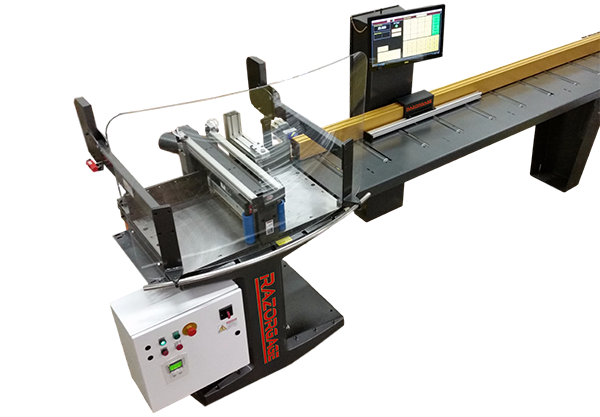
The RazorGage RG3 Automatic Saw Measuring System is a material positioning system. It moves to a programmed length and can run as a length stop or as an automatic pusher. It does not cut anything.
The operator feeds the saw and makes each cut, while the RG3 handles positioning. It works with chop saws, miter saws, upcut saws, downcut saws, drill presses, and notching and punching machines, so it upgrades the saw station you already have instead of replacing it.
Manual positioning versus the RG3
Accuracy: Hand measuring depends on reading a tape and locking a stop correctly every time. The RG3 moves to the programmed length the same way every time.
Speed: The time saved on one cut is small. Across a full shift, it is significant.
Consistency: Repeatable positioning keeps results the same across jobs, operators, and shifts. For many shop owners, this matters most, because inconsistent output is hard to plan around.
Waste: Fewer positioning errors mean fewer scrapped parts, which adds up quickly in solid stock and finished profiles.
Workload: Operators still run the saw, but they are no longer the measuring device. That leaves more attention for quality and less fatigue at the end of the day.
Where the payoff shows up first
Cabinet shops see the payoff first, because hundreds of repeat cuts a day turn small savings per cut into real capacity. Door and window manufacturers are close behind, since their parts need to fit on the first try.
Glass and aluminum fabricators benefit as well, especially when lengths repeat. Any operation working from recurring cutlists gets that consistency without replacing its saw.
Positioning equipment versus an optimizing saw system
These two solve different problems, and mixing them up leads to buying the wrong machine.
The RG3 Positioner works with the saw you already run. Used as an automatic pusher system, it advances the material to each programmed length while the operator cycles the saw. Used as a length stop, it moves to the length, and the operator pushes the material against it.
The RazorGage APS is a different class of machine. It is an automated optimizing saw system that combines the RG3 with the Cyclone 600 Upcut Saw and RazorGage optimizing software, so one person can feed the saw and offload finished parts. Features like AutoList optimizing software and label printing come from the RazorGage positioner and software, not from the saw itself.
The choice comes down to where the bottleneck is. If the saw is sound and measuring is slowing you down, the RG3 is the fix. If volume and cutlist complexity have outgrown what one person at a manual saw station can handle, an automated optimizing saw system like the APS makes sense.
The short version
Moving beyond manual positioning brings accuracy, repeatability, and efficiency to the saw station. The RG3 Positioner takes repetitive measuring and adjusting off the operator, so shop output becomes predictable enough to plan around.
The right setup depends on your volume, your cutting requirements, and how much automation the work calls for. A RazorGage dealer can help match the equipment to your operation.
Ready to improve accuracy and consistency at the saw station you already have? Explore the RG3 Positioner and the full RazorGage product line at razorgage.com, or request a quote.
FAQs
What does the RG3 Positioner do?
It positions material to a programmed length, as a length stop or an automatic pusher, so cuts repeat accurately without hand measuring.
Is the RG3 a saw?
No. It’s positioning equipment that works alongside your existing saw. The operator still makes each cut.
Does it replace operators?
No. It removes the measuring, not the person. Operators focus on loading, cutting, and inspection.
When should I consider an optimizing saw system instead?
When volume and cutlist complexity justify combining feeding and cutting into one automated operation.