
What Makes Precision Cutting Technology Valuable for Cabinet Production
Cabinet production has always been about that one thing: accuracy. Every panel, door, drawer component, and frame has to come together in a consistent way, so the finished product looks right and actually meets customer expectations. If the cuts vary even a little, assembly gets noticeably harder, waste goes up, and production starts moving more slowly.
As cabinet shops grow, the old manual measuring and cutting steps often become the bottleneck. Operators end up spending a lot of time making adjustments, re-checking dimensions, and dealing with the material, instead of just producing parts. So more manufacturers are leaning toward advanced cutting solutions like the RazorGage Upcut Saw and automated optimization systems, not just for “more speed” but for better precision, smoother operations, and better profitability.
Whether you’re assembling cabinets or manufacturing doors and windows, precision cutting technology supports repeatable results while still letting you keep the workflow moving. RazorGage provides options that help shops reduce waste, increase output, and hold steady quality standards through every production run.
Why Precision Matters in Cabinet Production
In cabinet manufacturing, small cutting errors can turn into bigger problems later. A panel that ends up just a bit oversized might force rework. Then a drawer piece that’s slightly undersized can mess with the whole fit and how it actually works. And if this keeps happening more than once, productivity starts to slip.
Cabinetmakers really rely on consistent dimensions for doors, drawer boxes, face frames, shelves, and the panels too. Accuracy isn’t only about getting one correct part out of the machine. It’s more like producing hundreds, or even thousands, of matching pieces, over the entire production run.
Precision cutting systems help reduce that inconsistency by making sure the material is placed properly before each cut. When it’s done that way, scrap drops, assembly goes smoother, and the product quality stays steady from the first piece right through the last.
For shops building high volumes of cabinetry, repeatability can matter just about as much as speed. Precision technology tends to deliver both, without fuss.
The Limitations of Traditional Cabinet Saws
Many cabinet shops begin with conventional cutting equipment. While traditional cabinet saws remain valuable for many applications, they often create challenges as production demands increase.
Manual tape measurements introduce opportunities for human error. Operators must repeatedly measure, position, verify, and adjust material throughout the day. These repetitive tasks consume time and can lead to inconsistencies between parts.
Material handling also becomes more difficult during larger production runs. Operators may spend as much time positioning stock as they do cutting it. Fatigue increases throughout the shift, making accuracy harder to maintain.
Even some of the best cabinet table saws still rely heavily on operator skill and attention. As order volume grows, many shops discover that manual workflows limit their ability to scale efficiently.
This is where programmable positioning systems provide a significant advantage. By automating measurements and material positioning, manufacturers can improve consistency while reducing operator workload.
How Automated Measuring Systems Improve Efficiency
One of the biggest productivity gains in modern cabinet manufacturing comes from eliminating repeated manual measurements.
Automated positioning systems use digital controls to move material to precise locations quickly and consistently. Instead of measuring every cut, operators can rely on programmed dimensions that repeat accurately throughout the day.
RazorGage’s RGxT Saw Stop and RG3 Automatic Saw Measuring System help streamline cutting operations by providing precise positioning and repeatable cut lengths. These systems can significantly reduce setup time while improving accuracy across production runs.
When integrated into a workflow, programmable saw stops allow operators to move from one part dimension to another with minimal delay. Material positioning remains consistent, reducing mistakes and improving throughput.
The result is higher productivity without sacrificing precision.
The Role of Industrial Upcut Saw Technology
As production demands increase, many manufacturers look beyond traditional saw configurations and invest in dedicated industrial upcut saw systems.
Automated Upcut Saws differ from manual saws by providing controlled cutting motion, improved material holding, and greater production efficiency. RazorGage systems use clamps to securely hold material during cutting, ensuring accurate positioning throughout the process.
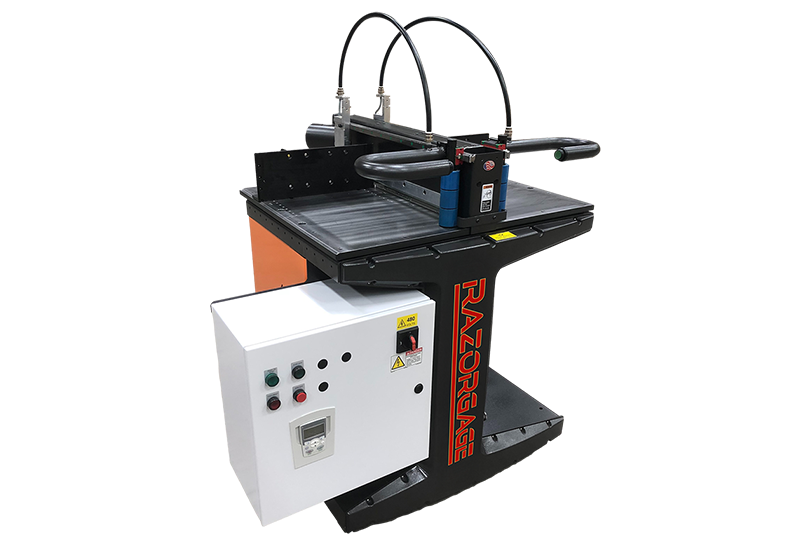
The RazorGage Cyclone 600 is designed specifically for demanding production environments. The industrial design incorporates a direct drive motor that glides on machine tool-grade, recirculating ball linear bearings, providing ultimate durability. This design reduces vibration while supporting long-term accuracy and reliability.
Unlike swing-arm saw designs that can introduce vibration and wear over time, the Cyclone 600’s linear-bearing system promotes smoother operation during continuous production.
The RazorGage Upcut Saw supports cabinet manufacturers who require accurate, repeatable cutting performance while maintaining efficient workflows and operator safety.
Material Optimization and Waste Reduction with RazorOptimal
Material costs represent a significant portion of cabinet production expenses. Even small improvements in material yield can have a substantial impact on profitability.
This is where RazorOptimal provides additional value. Rather than simply automating cutting, RazorOptimal helps optimize how material is used throughout the production process.
RazorOptimal can scan material for defects and intelligently arrange cut lists to maximize usable yield. Parts are positioned within defect-free areas whenever possible, reducing waste while improving finished product quality.
These optimization capabilities help shops minimize scrap, reduce unnecessary material consumption, and improve consistency across production runs.
For manufacturers processing large quantities of lumber or sheet stock, optimization often delivers measurable savings that continue over time.
Workflow Automation for Cutting Edge Cabinets
Today’s cutting-edge cabinets are produced in facilities that prioritize connected workflows rather than isolated operations.
Modern automation extends beyond cutting. Integrated systems can help reduce downtime between jobs while improving communication throughout the production process.
When combined with RazorGage’s optimizing solutions, options such as automated labeling, layout marking, and pocket hole processing can further improve efficiency. These integrated workflows reduce manual handling while helping operators move parts through production more effectively.
As labor challenges continue affecting the woodworking industry, automation allows shops to increase output without dramatically increasing staffing requirements.
This scalability is one of the reasons many growing manufacturers invest in connected production systems.
Improving Accuracy for Cutting Board Cabinet Components
Specialty components often require tighter tolerances than standard cabinet parts.
A custom cutting board cabinet insert, pull-out storage system, or decorative feature may demand greater precision to ensure proper fit and appearance. Even small dimensional inconsistencies can affect functionality and create costly rework.
Automated measuring systems help maintain consistency across these specialized applications by positioning material accurately before every cut. Repeatable measurements eliminate much of the variability associated with manual setups.
For high-end woodworking projects, precision technology provides the confidence that every component will match design specifications.
Whether producing custom cabinetry or specialty cabinet accessories, consistent accuracy remains essential to maintaining quality standards.
Choosing the Right Precision Cutting System for Cabinet Shops
Every cabinet manufacturer operates differently. Production volume, material type, labor availability, and product complexity all influence equipment requirements.
Some shops might get a boost from automated measuring systems, and yes, they can speed up the way things are already done. Still, other places end up needing full Optimizing Saws that bring Automated Upcut Saws together with material positioning systems and optimization software in one unified plan.
The right system keeps a balance between throughput, precision, protection, and flexibility. It should back the current production needs and, at the same time, leave some breathing space for future expansion.
RazorGage provides scalable options that let manufacturers sharpen precision, without dumping extra complications into the production flow. If a shop is modernizing just one cutting station, or rolling out a completely optimized workflow, the intention stays basically unchanged: make better parts faster and more reliably.
Conclusion
Precision cutting technology has become an essential piece in modern cabinet manufacturing, you know, where everything is supposed to line up. Getting exact measurements, keeping material securely positioned in a steady way, and using automated workflows all reduce waste while at the same time boosting production efficiency.
From automated measuring systems to advanced industrial upcut saw solutions, RazorGage offers the kind of tools that are built to provide long-term output and consistent quality. And when you pair that with optimization software like Auto-list, manufacturers can push higher throughput while staying with the accuracy that customers expect, not just for today but for the long haul.
So whether your shop is more focused on custom cabinetry or you’re running large-scale production, putting money into precision cutting technology can support a more efficient, more profitable, and genuinely more competitive business model.
Want to Improve Cabinet Production Efficiency?
Explore how RazorGage combines precision automation, Optimizing Saws, advanced measuring systems, and material optimization technology to help cabinet manufacturers increase accuracy and productivity.
Discover cabinet manufacturing solutions from RazorGage today.
FAQs
Why is precision cutting important in cabinet manufacturing?
Precision cutting ensures cabinet components fit correctly during assembly, reducing rework, waste, and installation issues while maintaining consistent quality.
How do automated measuring systems improve productivity?
They eliminate repeated manual measurements, improve cut consistency, and reduce setup time, allowing operators to produce more parts efficiently.
What is the difference between an Upcut Saw and an Optimizing Saw System?
An Automated Upcut Saw performs accurate cutting, while an Optimizing Saw System combines the saw with positioners and software to automate material optimization and production workflows.
How does RazorOptimal help reduce waste?
RazorOptimal identifies defects and optimizes cut layouts, helping manufacturers maximize material yield and reduce scrap.