

Why Glass Industry Manufacturers Are Switching to Automated Cutting Systems
The glass industry has changed significantly over the last decade. Commercial projects are larger, schedules are tighter, and customers expect greater consistency than ever before. In today’s environment, even small production errors can create expensive delays during installation. That is one reason many fabrication shops are investing in automatic saw system technology to improve accuracy and efficiency.
For companies involved in commercial glass fabrication, precision is not optional. When it comes to framing parts, aluminum extrusions, vinyl profiles, and the actual structural materials, everything needs to be cut just right, every single time. The old manual measuring approach that used to work fine for smaller jobs, somehow can’t keep up anymore with today’s faster production. That’s why automated cutting systems are being used more and more; they help makers cut down on mistakes, raise output, and keep the whole workflow a lot more consistent, in practice.
As competition increases across the industry, automation is becoming less of a luxury and more of a practical business decision.
The Growing Demands in Commercial Glass Fabrication
Today, any commercial building construction project calls for very precise specifications. Perfectly cut framing parts are essential to curtain walls, storefronts, glass entrances, and window assemblies. Even a slight mismatch could lead to alignment problems, which can become a costly issue during installation.
Production volume has grown, and delivery windows have been reduced for many fabricators. Customers demand quick turnaround time without compromising the quality. As the workload increases, meeting those expectations using manual measuring and cutting is becoming challenging.
Traditional tape measure workflows are very operator-dependent. It can be difficult for an employee to maintain consistency across multiple shifts, changing workloads, and varying production demands, but it’s possible with skilled employees.
Automation enables manufacturers to keep the same degree of accuracy irrespective of volumes produced. Digital positioning systems provide repeatable results all day long without depending completely on manual measurements.
Why Traditional Cutting Methods Are Becoming Inefficient
Many fabrication facilities still rely on manual stops, repeated measurements, and operator judgment to position materials. While these methods may seem familiar, they often introduce inefficiencies that limit productivity.
Whenever an operator measures material by hand, there’s this opening for error, kind of an uninvited little problem. Even minor slips can snowball into cumulative inaccuracies over long production runs. Double-checking measurements takes up real, valuable time on the floor, so output slows down, and the labor costs start rising, too.
There’s also the issue of consistency. Two operators might handle the same task in different ways, and that leads to differences in cut quality and dimensional accuracy. When projects get more intricate, those small variations don’t just stay in one spot; they can carry over into downstream assembly and later installation.
A lot of older cutting systems, unfortunately, make operators spend more time measuring than actually producing. So shops that rely on manual workflows often end up fighting just to keep pace with competitors, the ones that moved to automated solutions for speed and efficiency.
How Automatic Saw Systems Improve Accuracy
An automatic saw system removes many of the variables that contribute to cutting errors. Instead of manually positioning material for every cut, digital measuring systems automatically move stock to precise locations.
This process creates repeatable accuracy across entire production runs. Once measurements are programmed into the system, operators can produce consistent results without repeated measuring and marking.
Automated positioning also reduces cumulative error. Since the system references digital measurements rather than manual calculations, accuracy remains consistent from the first cut to the last.
For glass framing applications, maintaining tight tolerances is critical. Aluminum, vinyl, and wood framing components must fit together correctly during assembly and installation. Automated positioning systems help ensure dimensional consistency while reducing scrap and rework.
The result is improved product quality, reduced waste, and greater confidence throughout the manufacturing process.
The Role of RazorGage in Modern Glass Manufacturing
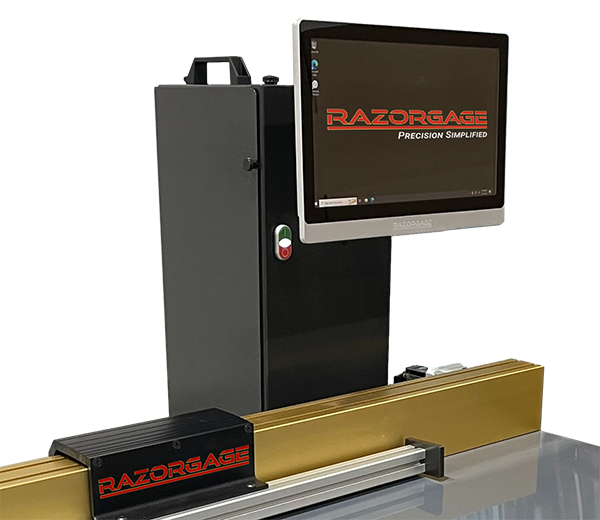
RazorGage has built its reputation around helping manufacturers improve measuring accuracy and production efficiency. Rather than relying on manual measuring methods, RazorGage systems automate material positioning to streamline cutting operations.
The RG3 automatic saw measuring system cuts down on a lot of the delays that show up with manual measuring. Material can be set in place fast, and still stay accurate, which helps the setup time slip way down between cuts. At the same time, you keep that repeatable precision, you know, the kind you don’t have to babysit.
For the higher-volume stuff, the APS Auto Pusher System brings a more efficient approach to positioning, feeding and cutting. It makes it easier for one operator to keep production moving more smoothly, while also reducing fatigue during those repetitive cutting runs.
RazorGage positioning systems integrate with chop saws, automated upcut saws, and downcut saws, so fabrication shops can put together workflows that align with whatever production needs they have, not some generic plan.
And really, whether you’re building cabinets or manufacturing doors and windows, the main idea stays the same. When the positioning is accurate, productivity goes up, and those expensive mistakes tend to go down.
Why Optimization Software Matters in Fabrication
Accurate cutting is only part of the equation. Material utilization plays a major role in profitability, especially when working with expensive framing components.
RazorGage’s optimizing saw systems can integrate AutoList optimization software to improve cutting efficiency. The software calculates optimized cut sequences designed to maximize material yield while minimizing waste.
This capability helps manufacturers make better use of raw materials while simplifying production planning. Instead of manually calculating cutting patterns, operators can work from optimized cut lists generated automatically by the system.
Optimization also improves consistency between shifts and operators. Standardized workflows reduce variation and help maintain predictable production output throughout the facility.
For companies looking to improve profitability without sacrificing quality, optimization software can deliver measurable benefits.
Advantages of Upcut Saws for Commercial Glass Framing Components
Many fabrication facilities searching for an upcut saw for sale are looking for ways to improve cut quality, consistency, and operator safety.
Automated upcut saws provide stable cutting performance for aluminum, vinyl, and other framing materials commonly used in glass manufacturing. RazorGage’s Cyclone 600 Upcut Saw was designed specifically for demanding industrial environments.
The industrial design incorporates a direct-drive motor that glides on machine tool-grade, recirculating ball linear bearings, providing ultimate durability. Unlike swing-arm designs that can introduce vibration and wear over time, this system helps maintain long-term cutting performance.
Material stability is equally important. RazorGage uses clamps to securely hold stock during cutting operations. These clamps help maintain accurate positioning while supporting smooth cutting motion for clean, consistent results.
For fabrication facilities evaluating an upcut saw for sale, durability, precision, and reliability remain key factors in the decision-making process.
How Automation Helps Reduce Labor Challenges
Labor shortages still mess with manufacturing operations across many sectors, and it feels like it keeps happening. Finding seasoned operators is getting harder and harder, plus training newcomers takes time and resources that nobody really has to spare.
Automation tends to help with that by making the everyday steps simpler and by reducing how much the work depends on super-specialized having experienced operators. With digital positioning systems, operators are guided through production processes in a way that stays accurate and consistent, even when things get busy or tight.
So new hires can ramp up faster because the system takes care of a lot of the measuring and the positioning routine. Even the experienced operators end up better off, since they’re not stuck spending so much time on the repetitive measuring chores, over and over again.
In many cases, automation allows a single operator to manage multiple production responsibilities more efficiently. This improves output without requiring significant increases in labor costs.
For growing fabrication shops, these efficiencies can make a substantial difference in overall productivity.
Ideal Applications for Automated Cutting Systems
Automated cutting tech supports a broad set of glass industry use cases. It does a lot more than people think in the beginning. For commercial window framing production, you get repeatable accuracy plus faster throughput, without the usual drift. For curtain wall fabrication, there’s a need for very tight dimensional control, so the assembly and installation actually line up. Glass door manufacturers also depend on steady component sizing, because quality has to stay consistent across lots.
On top of that, these automation setups are pretty useful for cutting aluminum spacers, structural framing parts, and other materials that show up during fabrication work, in everyday operations.
Higher volume production plants usually see the biggest gains, because automation helps keep the process stable while output keeps going up. Still, even smaller workshops can benefit by cutting down measuring time, making better use of material, and smoothing workflow efficiency.
Conclusion
Commercial glass manufacturers are getting more pressure to put out better quality products in less time while keeping material and labor costs under control. Using manual cutting methods can make those targets really hard to reach, because there’s more room for small mistakes and delays.
Automated cutting systems can cut down on measurement errors, save on scrap, improve repeatability, and support a smoother production flow. When facilities combine precision positioning tech, optimization software, and industrial saws, RazorGage becomes a practical way to help fabrication shops satisfy today’s manufacturing expectations, without all the usual hassle.
And as projects keep getting bigger, more complicated, and competition keeps tightening, automation offers manufacturers a solid route to stronger output, improved precision, and better long-term profitability.
Ready to Improve Your Fabrication Workflow?
If your operation is looking to improve cutting accuracy, reduce waste, and increase production efficiency, RazorGage offers proven solutions designed for modern fabrication environments. From automated positioning systems to industrial saw integration and advanced optimization software, RazorGage helps manufacturers stay competitive.
Explore precision automation solutions and discover how RazorGage can support your next upcut saw for sale evaluation and overall production goals.
FAQs
Why Are Glass Manufacturers Adopting Automated Cutting Systems?
Automated cutting systems improve measuring accuracy, reduce material waste, and increase production speed. They also help maintain consistency across operators and production shifts.
How Does an Automatic Saw System Improve Productivity?
An Automatic Saw System positions material digitally, eliminating repeated manual measurements. This reduces setup time and helps operators produce accurate cuts more efficiently.
What Role Does Optimization Software Play in Fabrication?
Optimization software creates efficient cutting layouts that reduce scrap and improve material yield. It also helps standardize production workflows across the facility.
Are Automated Systems Only Beneficial for Large Fabrication Shops?
No. Small and mid-sized operations can also benefit from reduced measuring time, improved accuracy, and more consistent production results.