

How Can Cabinet Manufacturers Improve Cutting Workflow With Automation?
Cabinet manufacturing depends on speed, accuracy, and the ability to repeat the same cut without creating more work for the operator. That sounds straightforward until a shop is making hundreds of parts in a day. Measuring stock, moving it into position, checking the length, and repeating the process for every cut can take up a surprising amount of time. Even a small positioning mistake can lead to a bad part, rework, or wasted material.
This is where an automatic pusher and automated positioning can make a real difference. Instead of asking an operator to manually measure and reposition material for every cut, the system can move stock to the programmed cutting position. RazorGage systems are designed to add this kind of control without forcing furniture manufacturers to completely rebuild their existing cutting workflow. The result is a more consistent process with less repetitive handling.
Common Cutting Workflow Problems in Cabinet Manufacturing
Manual cutting has its place. It gives operators direct control and works well for custom jobs or lower production volumes. The problem starts when the same measuring and positioning steps have to be repeated all day.
An operator may measure a piece, move it to the stop, check the measurement, make the cut, and then start again. Do that hundreds of times, and the repetitive work adds up quickly. It also creates more opportunities for small mistakes.
A measurement that is slightly off may not seem serious on one part. But when several components need to fit together, those small differences can cause problems during assembly. Parts may need to be recut, material may be wasted, and production slows down.
There is also the issue of operator fatigue. When production speed depends on how quickly someone can measure and reposition material, output can vary between operators and shifts. Shops handling high-volume orders need a process that is repeatable without requiring someone to rush through every measurement.
What Is Automated Material Positioning?
Automated material positioning controls where the material sits before it is cut. Instead of manually measuring each piece and moving it into position, the system can use programmed measurements to position the stock for the next cut.
An automatic pusher and stop system takes this idea further. The pusher moves the material to the required position, while the stop or measuring system helps maintain the correct cutting length. This reduces the amount of manual measuring between cuts.
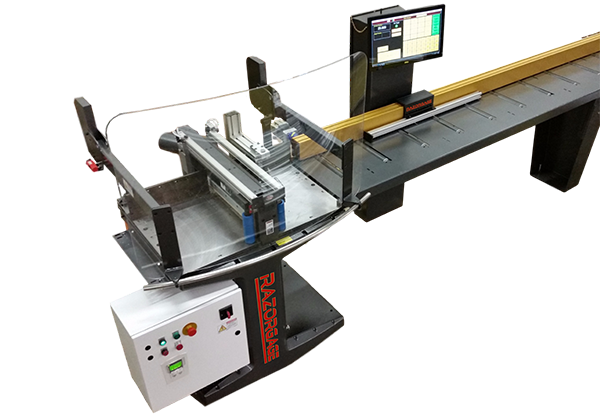
That does not mean every shop needs to replace its saw with a completely automated machine. Positioning technology can work alongside existing equipment. For example, the RazorGage RG3 Saw Measuring System can provide positioning as an automatic pusher or saw measuring stop alongside a saw such as the Cyclone 600 manual Upcut Saw or an industrial chop saw.
That distinction matters. The RG3 is responsible for positioning and measuring. It is not the saw itself.
How an Automatic Pusher Changes the Cutting Process
The biggest change is simple: the operator no longer has to manually measure and reposition every piece.
Once the required length is programmed, the positioning system moves the stock to the correct cutting position. The operator can then make the cut and continue with the next part. For repeated dimensions, this can remove a lot of unnecessary movement from the workflow.
An automatic pusher is particularly useful when a Cabinet shop runs the same dimensions repeatedly. Cabinet components, frames, rails, stiles, shelving parts, and trim can all involve repeated cutting sequences. When the same measurement comes up again and again, there is little value in making the operator manually confirm it every time.
The RG3 Automatic Saw Measuring System can provide this positioning function alongside a compatible saw. It can act as an automatic pusher or saw measuring stop, giving the operator more control over the cutting process while reducing repetitive measuring.
The benefit is not only speed. Automated positioning also makes the process more consistent between operators. A cutlist can be followed with less reliance on someone remembering or rechecking every measurement by hand.
Using an Automatic Chop Saw for Faster Production
A repetitive cutting operation can become much easier to manage when positioning is automated. An automatic chop saw setup can help furniture manufacturers maintain consistent cut lengths while reducing the time spent measuring between cuts.
The saw still performs the cutting. The positioning system handles the material placement. Keeping those functions clear helps avoid confusion about what the automation actually does.
For Cabinet production, this can be useful for components that require many repeated cuts. Think about rails for cabinet frames, shelving parts, trim, or other pieces that are produced in batches.
Instead of measuring each piece from scratch, the operator can work from programmed dimensions. That keeps production moving without forcing the operator to rush through manual measurements.
RazorGage systems can be integrated with chop saws and other cutting equipment, depending on the production setup. This gives shops a way to improve material positioning without automatically committing to a completely new cutting line.
Benefits of Automating Material Feeding
The value of automation becomes easier to see when you look at the small tasks it removes from the production process.
Faster Cutting Cycles
Less time spent measuring and repositioning means more time available for actual cutting and material handling. The difference may be small on one part, but repeated hundreds of times, it becomes much more noticeable.
Better Repeatability
Automated positioning helps place material at consistent programmed lengths. This reduces the variation that can happen when every measurement depends on manual setup.
Less Material Waste
Positioning mistakes can create unusable parts. Better control helps reduce those errors and makes more of the stock material usable.
Less Repetitive Operator Work
Operators do not have to spend the entire shift repeating the same measuring and feeding motions. That can make the workflow easier to manage, especially during long production runs.
Smoother Production Flow
When the positioning process is more predictable, operators can spend more time monitoring the work, handling finished parts, and preparing the next material instead of constantly reaching for a tape measure.
Easier Scaling
As production volume grows, repetitive manual steps become more expensive in terms of time and labor. Automation becomes more useful when the same cutting sequences are repeated throughout the day.
These are practical gains. The goal is not to automate something just because it can be automated. The goal is to remove unnecessary steps that slow the shop down.
Where Cabinet and Furniture Manufacturers Can Use Cutting Automation
Cutting automation can fit into several areas of production. Cabinet and casework shops may use automated positioning for repeated frame and panel components. Furniture manufacturers can use it for structural parts, table components, shelving, and storage systems.
It can also help with repetitive trim and molding cuts where the same lengths are produced in batches. Shops cutting multiple components from the same stock material may see an even greater benefit because positioning becomes part of a repeatable sequence rather than a separate manual task for every piece.
The biggest difference usually shows up when the same cutting process happens again and again. If an operator is measuring the same few dimensions throughout the day, there is a good chance that positioning automation can remove some unnecessary work.
Combining Positioning, Measuring, and Optimization
Positioning is only one part of the larger cutting workflow. Once a shop starts looking at automation as a complete process, positioning, measurement, and material optimization can work together.
The RG3 Saw Measuring System can provide automated material positioning as an automatic pusher or saw measuring stop. It gives the operator a more controlled way to position stock for cutting.
The APS, or Auto Pusher System, takes this further. It is an automated optimizing saw system, not simply an automatic pusher. It combines the automated Cyclone 600 Upcut Saw with the RG3 to optimize and cut material. This setup allows one operator to feed the saw and offload finished parts as part of the same workflow.
For shops concerned about material use, RazorOptimal adds another layer. It is a programmable optimizing saw system designed to identify defects and optimize the remaining cuts around usable material. That can help manufacturers get more usable parts from the stock they already have.
This distinction between systems is important. The RG3 handles positioning and measuring. The APS combines the automated saw and positioning system into an optimizing saw system. RazorOptimal focuses on optimizing the cutting plan around available material.
Furniture components can also require angled cuts. When that happens, the RazorGage AngleMaster can support semi-automatic angle cutting for applications where precise miter cuts are needed. Not every job needs the same level of automation, so having different options can be useful for shops with mixed production schedules.
Conclusions
Cabinet manufacturers do not always need to replace their entire cutting setup to improve production. Sometimes the bigger opportunity is removing the repetitive steps that happen before the cut.
Automated material positioning, automatic pushers, and saw measuring technology can reduce manual measuring and repositioning while helping maintain consistent cutting lengths. For shops producing repeated parts, that can mean faster cycles, less wasted movement, and a more predictable workflow.
The important thing is choosing the right level of automation. A positioning system such as the RG3 can improve an existing setup, while an automated optimizing saw system such as the APS combines positioning, cutting, and optimization into a more complete workflow.
For Cabinet manufacturers looking to improve accuracy, efficiency, and material use without adding unnecessary complexity, automation can be a practical next step.
FAQs
What Is an Automatic Pusher Used For?
An automatic pusher moves material to a programmed cutting position. It reduces the need for manual measuring and repositioning between repeated cuts.
Can Automated Positioning Work with Existing Saws?
Yes. Systems such as the RG3 can work alongside compatible cutting equipment, including manual saw setups.
Does Automation Reduce Material Waste?
It can. More consistent positioning reduces measurement mistakes, while optimizing systems can help plan cuts around usable material.
What Is the APS System?
The APS is an automated optimizing saw system that combines the automated Cyclone 600 Upcut Saw with the RG3 to optimize and cut material.
Improve Your Cutting Workflow With RazorGage
If repeated measuring and material handling are slowing production, it may be time to look at a more controlled approach. Explore RazorGage solutions for automated positioning, optimizing saw systems, and more.
Discover cutting automation solutions at https://razorgage.com/.