
What Makes Automated Cutting Equipment Essential for Mechanical Contractors?
Mechanical contractors frequently work with materials that must be cut precisely, consistently, and in a timely manner. While the materials themselves seem simple, creating practical solutions for cutting steel pipe, aluminum, copper, and PVC pipe became more difficult as each piece had to be measured, positioned, and inspected by hand. The slightest error in measurement means another cut that needs to be re-cut or wasted material.
That’s where an automatic saw system can help a lot. Automated cutting equipment offers more control when measuring and positioning can be repeated over and over throughout the day. Automatic positioning systems and pushing and angle cutting systems can minimize repetitive tasks and ensure contractors can achieve consistent results on larger production runs.
The Cutting Challenges Mechanical Contractors Face
Manual cutting is not necessarily a problem for every shop. For smaller jobs or occasional cuts, an operator with a tape measure and a good saw can get the work done.
The problem starts when the same process has to be repeated dozens or hundreds of times.
Every manual measurement creates another opportunity for error. An operator has to measure the material, mark the cut, position the stock, make the cut, and then repeat the entire process. Over a full production shift, those small steps consume a surprising amount of time.
Material handling adds another layer.
Walking time between measuring points, saws, and stock is more time-consuming than concentrating on production. If several operators are on different shifts, keeping the same degree of accuracy may also be challenging.
Not to mention waste. An incorrect measurement for an expensive piece of steel, aluminum, or copper is no mere inconvenience. This material may need to be scrapped or re-cut, which adds to material expenses and production lead time.
What is an Automatic Saw System?
The automatic saw system integrates the functions of material measurement, positioning, and cutting in a more controlled way. The system assists in positioning material with greater accuracy to achieve the desired cut, rather than manually measuring each part and setting the stop by hand.
The beauty is that it is repeatable.
After the required length is determined, the positioning system can transport the material to the desired location repeatedly. Although the operator is still involved, repetitive measurement and positioning tasks are significantly reduced.
For mechanical contractors that are running production runs, this could make a big difference. Repeatable positioning is essential to obtaining repeatable dimensions on parts produced, and automated movement can provide the time savings between cuts.
The idea is not to take the operator out of the process. It’s to provide the operator with more control over it.
The concept is the foundation of RazorGage systems, which integrate precise positioning and cutting technologies to optimize workflow. The different technologies of positioning, pushing, angle cutting and optimization can be combined with other technologies to create a complete automated solution for the contractor, depending on the application.
How an Automatic Pusher System Improves Workflow
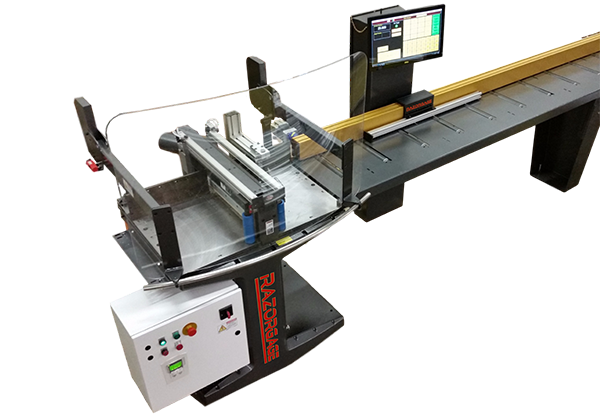
Moving material into position is one of the most repetitive parts of a cutting operation. An APS- Automatic Pusher System can take over that part of the process, helping move stock to the programmed cutting position and automatically cycling the saw instead of requiring the operator to measure and reposition it manually each time.
RazorGage’s APS is designed so one person can feed the saw and offload finished parts. That can simplify the workflow considerably.
Instead of having one person constantly measuring while another handles the saw, the process can be organized around a more controlled material flow. The operator can focus on feeding material, making the cut, and handling finished parts rather than repeating the same measurement steps.
This also helps maintain consistent positioning from one cut to the next. When the same dimensions need to be produced throughout a run, automated positioning reduces the variation that can come from repeated manual measurements.
For a contractor trying to increase production without simply adding more labor, that matters.
Automation does not magically make every shop faster. The material, saw, workflow, and production volume all matter. But when repetitive cutting is taking up too much labor time, an automated pusher can remove a significant part of that workload.
The Role of Automated Miter Saw Systems
Not every cut is a straight cut.
Mechanical contractors may also need angled cuts when producing components that have to fit together during fabrication or installation. Manual angle adjustments can take time, especially when the required angles change throughout a job.
Automated miter saw systems can help make these changes more repeatable by controlling the positioning required for angle cuts.
RazorGage AngleMaster takes a flexible approach. It provides semi-automatic angle cutting, allowing operators to make angle changes without relying entirely on manual measuring and positioning.
That flexibility is useful when a production run includes different angles. Operators can maintain control while still benefiting from more repeatable positioning.
For larger or more repetitive jobs, RazorGage’s AngleMaster Auto90 package can add automatic operation for groups containing only 90° cuts. When a group includes different angles, the system can use semi-automatic operation instead. This helps avoid forcing mixed-angle parts through an automatic process where angle drops could create problems. The result is a workflow that adapts to the job instead of requiring every job to follow the same cutting method.
Reducing Waste With Automated Cutting Technology
Waste is one of the easiest ways cutting mistakes can increase production costs.
A wrong measurement can turn usable stock into scrap. Repeated positioning errors can create parts that do not meet specifications. Even when the material itself is expensive, the labor and machine time spent producing a bad part add to the loss.
Automated cutting equipment helps address this by improving positioning and repeatability. For mechanical contractors, this is especially relevant because common materials include steel pipe, aluminum, copper, and PVC pipe. These materials are not always inexpensive, and unnecessary cuts can quickly add up across a production run.
RazorGage optimization technology can take this a step further. An optimizing saw system can use available material more effectively by determining how parts should be positioned for cutting. This is different from simply using a saw with an automatic pusher.
The pusher handles material movement. The positioning system controls where the material goes. Optimization software can help determine how the required cuts should be arranged to make better use of available stock.
That is where waste reduction in manufacturing becomes more than just a general production goal. Better planning and more accurate cutting can help contractors get more usable parts from the material they already paid for.
Why Accuracy Matters for Mechanical Contractors
Cutting accuracy does not stop mattering once a part leaves the saw.
A component that is slightly off can create problems during fabrication, assembly, or installation. Workers may need to make adjustments, recut parts, or find another way to compensate for an inaccurate dimension.
That is why repeatability matters just as much as individual cut accuracy. An automated positioning system reduces the need for operators to measure the same dimension over and over. Once a position is established, the system can return material to that position consistently.
This also reduces the dependence on individual operator technique. Experienced operators will always be valuable, but the process should not rely entirely on one person’s ability to measure and position every part perfectly.
For high-volume work, that consistency becomes even more important. Producing one accurate part is one thing. Producing hundreds of parts with the same dimensions is a different challenge.
Automation helps make that repeatability part of the process.
Choosing the Right Automated Industrial Saw System
Not every mechanical contractor needs the same level of automation.
The right system depends on the type and size of material being cut, production volume, required cut lengths, angle requirements, and the existing saw setup.
Start with the basic workflow. Is the main problem manual measuring? Is material positioning taking too much time? Are angle changes slowing production? Or is material waste becoming a larger concern?
From there, contractors can determine which level of automation actually makes sense. A positioning system may be enough for one operation. Another may benefit from an automatic pusher. Shops handling frequent angle cuts may need AngleMaster. Larger operations may benefit from combining positioning, pushing, cutting, and optimization into one workflow.
It is also worth considering how the equipment will be used day after day. An automated industrial saw system should fit the existing production process rather than forcing the entire shop to work around the equipment.
Labor savings are part of the equation, but they are not the only factor. Reduced errors, improved throughput, less material waste, and more consistent production can all contribute to the long-term value of automation.
Conclusions
Automation isn’t a necessity for mechanical contractors just because it’s modern. It is required when repetitive cutting, measuring, positioning, and material movements are slowing production.
Repeatability can be enhanced by automatic positioning. Manual handling can be minimized by automatic pushing. AngleMaster may make cutting easier, and optimized technology can assist contractors in utilizing material.
The appropriate setup depends on the task at hand. A small shop could require a single automation element, whereas a high-volume shop could be served by a full positioning/pushing/cutting/optimization system.
Automation offers the benefit of increased accuracy, productivity and material savings when equipment is used in the workflow. This can lead to fewer errors, less rework, and a smoother production process, from start to finish.
Improve Your Cutting Workflow With RazorGage
If repetitive measuring, positioning, and material handling are slowing production, it may be time to look at a more controlled cutting workflow. RazorGage offers positioning, pushing, angle-cutting, and optimization solutions designed for demanding production environments. Explore automatic cutting saw system solutions and see how RazorGage can help improve accuracy, throughput, and material usage.
FAQs
What Materials Can Mechanical Contractors Cut with Automated Equipment?
Mechanical contractors commonly cut steel pipe, aluminum, copper, and PVC pipe. The right saw and automation setup depend on the material, size, and production requirements.
Does Automation Eliminate the Need for an Operator?
No. Automation reduces repetitive measuring, positioning, and material-handling tasks, but operators still manage feeding, cutting, and finished parts.
Can Automated Systems Help Reduce Material Waste?
Yes. More accurate positioning reduces mistakes, while optimizing technology can help determine better ways to use available stock.
Is an Automatic Saw System Suitable for Every Shop?
Not necessarily. The value depends on production volume, material type, cut requirements, and the amount of repetitive manual work in the current process.
Visit RazorGage to explore automated cutting solutions: https://razorgage.com