
Automatic vs Semi-Automatic Angle Cutting: Why RazorGage AngleMaster Uses Both
Angle cutting is one of those processes that looks simple until you’re responsible for getting it right all day, every day. A few degrees off doesn’t sound like much, but when you multiply that error across a full production run, it quickly turns into scrap, rework, and frustration. Shops that rely on manual angle setups know this pain well. Accuracy depends heavily on the operator, setup time is inconsistent, and repeatability can be hard to maintain.
That’s exactly where the RazorGage AngleMaster fits. Rather than trying to put the shops in either an entirely manual or automated workflow, RazorGauge offers a hybrid angle cutting solution. It combines automatic and semi-automatic cutting of angles to allow the shops to select the level of control that is reasonable in the job at hand. That flexibility is more important than many are aware, regardless of whether you are constructing cabinets or producing doors and windows.
The Complexity of Angle Cutting
Angle cutting introduces challenges that straight cutting simply doesn’t. Every angle change adds setup time. Every setup introduces the possibility of error. With manual systems, alignment depends on careful measuring, locking, rechecking, and hoping nothing moved during the process.
Even skilled operators can struggle to repeat the same angle consistently over long shifts. Fatigue, distractions, and minor adjustments all affect results. When angle requirements change frequently, recalibration becomes a constant interruption instead of a one-time setup.
The real problem isn’t just accuracy on a single cut. It’s a cumulative error. Slight inconsistencies compound across parts, leading to poor fit, wasted material, and downstream issues during assembly. That’s why angle cutting demands more than just a good saw. It requires reliable positioning and repeatable control.
Automatic Angle Cutting: Strengths and Limits
Automatic angle cutting systems were developed to remove variability from the process. Once angles are set digitally, repeatability improves dramatically. Operator involvement is reduced, and long production runs benefit from consistent output.
For high-volume jobs, cutting the same angle on every piece, automation makes sense. The system does the same thing over and over, delivering uniform results shift after shift. It also helps standardize production across multiple operators, which can be a major advantage in larger shops.
Full automation isn’t always ideal. Shops running short batches, custom angles, or mixed jobs often find fully automatic systems restrictive. Changing angles can involve reprogramming steps that take longer than manual adjustments. In some cases, the automation itself becomes the bottleneck.
There’s also the cost-to-benefit equation. Not every operation needs maximum automation to be productive. For many shops, flexibility is just as important as repeatability.
Semi-Automatic Angle Cutting: Where It Excels
Semi-automatic angle cutting keeps the operator involved while still delivering reliable accuracy. Instead of fully manual measuring and locking, semi-automatic systems provide controlled positioning with faster setup changes.
This approach works especially well in shops handling varied production schedules. Operators can adjust angles quickly without navigating complex programming. That speed matters when switching between jobs multiple times a day.
Another advantage is control. Semi-automatic systems allow operators to visually confirm settings and make small adjustments when needed. For custom work, that hands-on involvement can actually improve results rather than slow things down.
Training also tends to be easier. Operators understand what the system is doing, which builds confidence and reduces mistakes. For many shops, semi-automatic angle cutting hits the sweet spot between accuracy and adaptability.
Why RazorGage AngleMaster Uses Both
RazorGage didn’t assume every shop works the same way. The AngleMaster was designed with real-world workflows in mind, not idealized production scenarios.
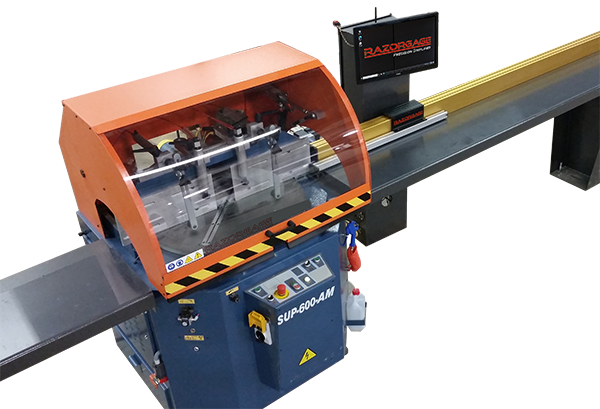
By supporting both automatic and semi-automatic angle cutting, the AngleMaster lets shops choose how much automation they need, depending on the job specifications. Jobs that have a cutlist of parts with a 90° angle for the entire run benefit from repeatable automatic positioning. For jobs where the cutlist has parts with multiple angles to be cut, the semi-automatic mode for AngleMaster will be needed.
This hybrid design means you don’t have to reconfigure your process or invest in separate systems to handle different workloads. One solution adapts to multiple production styles. That flexibility is what makes the AngleMaster practical, not just technically impressive.
It’s also a scalable approach. Shops can start semi-automatic and move toward more automation as production demands change, without replacing equipment. To run the AngleMaster in a fully automatic mode requires Razorgage’s AngleMaster Auto90 Package. The Auto90 package does not come standard with AngleMaster saw systems.
How the AngleMaster Auto90 Package Works
The AngleMaster Auto90 package was developed to address the real-world problems associated with cutting angled parts in automatic mode.
When a cutlist is opened, the Auto90 software automatically sorts parts into groups. If a group contains only 90° cuts, the system runs that group in full automatic mode. This allows efficient, uninterrupted production where automation provides the most benefit.
When a group contains parts with varying angles, the system switches to semi-automatic mode. This gives the operator the opportunity to clear angle drops that could otherwise jam the system. By switching modes intelligently, Auto90 prevents the issues that commonly occur when angled parts are forced through automatic pusher systems.
This hybrid approach allows shops to take advantage of automation without sacrificing reliability or uptime.
Precision Through Intelligent Positioning
Angle accuracy requires proper positioning of the blade as well as accurate material positioning throughout the run. Poor positioning leads to inconsistent results, no matter how good the saw is.
RazorGage focuses heavily on precise, repeatable material positioning systems that eliminate guesswork. Digital controls allow operators to return to exact angle settings without re-measuring or relying on visual estimates. Once a setting is established, it stays consistent.
Equally important is material holding. RazorGage systems use clamps, manual or automatic, to secure material during cutting. The clamps hold the stock firmly in place, ensuring clean, accurate cuts without relying on blade pressure or operator force.
This controlled approach reduces variability and improves cut quality across operators and shifts. It’s a fundamental part of why RazorGage systems deliver dependable results in demanding shop environments.
Productivity Gains Across Applications
Hybrid angle cutting isn’t just about accuracy. It’s about output. Faster setup changes mean less downtime between jobs. Operators spend less time measuring and adjusting and more time producing usable parts.
Consistency improves across the board. Angle accuracy doesn’t drift throughout the day, and results remain stable even during long production runs. That consistency reduces scrap and rework, which directly impacts profitability.
For cabinet shops, door manufacturers, and window producers, these gains show up quickly. Parts fit better. Assembly goes more smoothly. Fewer mistakes make it downstream. Over time, those small improvements add up to significant efficiency gains.
Conclusion
Angle cutting demands more than a one-size-fits-all solution. Manual systems struggle with consistency, while fully automatic systems can limit flexibility. The RazorGage AngleMaster was designed to bridge that gap.
By combining automatic and semi-automatic angle cutting, RazorGage delivers a solution that adapts to real shop workflows. It provides precision without sacrificing control and efficiency without forcing unnecessary automation.
For shops that value accuracy, flexibility, and long-term reliability, this hybrid approach isn’t just convenient; it’s smart.
Want flexible, accurate angle cutting without locking yourself into full automation?
Learn how RazorGage integrates the material positioning systems that power its optimizing solutions.
Explore the AngleMaster and more at RazorGage.
FAQs
Why does RazorGage use a hybrid angle cutting approach?
Different jobs require different levels of control. A hybrid system allows shops to use automation when it adds value and manual control when flexibility matters more.
Is automatic angle cutting better than semi-automatic?
Not always. Automatic cutting excels in long, repetitive runs, while semi-automatic systems are better suited for custom work and frequent changes.
How do material positioning systems improve accuracy?
Accurate material positioning systems ensure consistent part lengths, reducing cumulative errors and operator guesswork.
Who benefits most from the AngleMaster?
Shops handling mixed production schedules, custom angles, or a combination of short and long runs benefit the most from its flexibility.