
Chop Saw Measuring System with Cutlist Software: How It Works
Walk into almost any busy shop, and you’ll still see the same routine playing out. Tape measure out. Pencil marks on stock. Double-checking dimensions because the last cut was off by a fraction. Manual measuring on a chop saw gets the job done, but it slows production and invites mistakes, especially when you’re cutting hundreds of parts a day.
As shops move toward tighter tolerances and faster turnaround, that old process starts to break down. Digital workflows demand repeatability, accuracy, and less guesswork. That’s where a chop saw measuring system paired with cutlist software changes everything. Instead of measuring each cut by hand, the system positions material automatically and lets the operator focus on making clean, consistent cuts.
This article breaks down how these systems work, how software fits into the process, and why the RazorGage Positioner has become a practical upgrade for shops that want accuracy without overcomplicating their operation.
The Basics of a Chop Saw Measuring System
At its core, a chop saw measuring system replaces manual tape measuring with automated length positioning. Instead of pulling a tape and marking each piece, the operator feeds material against a digital stop or pusher that moves to an exact programmed length.
The measuring system mounts alongside an existing chop saw, so you’re not replacing the saw itself. The saw still does what it’s always done: cut material. The difference is how the length is set. Digital positioning ensures every cut hits the same dimension, whether it’s the first piece or the hundredth.
This approach removes small inconsistencies that creep in with manual measuring. Fatigue, misread tape marks, and rushed setups all disappear when the length is set automatically. The result is consistent accuracy without slowing down production.
Role of Cutlist Software in Production
Cutlist software is where the planning happens before the material ever reaches the saw. Instead of reading drawings or handwritten notes, the operator works from a digital cutlist that organizes every part length in advance.
The software eliminates manual interpretation. Dimensions are entered once, reviewed, and then sent directly to the measuring system. That direct connection reduces the chance of human error and keeps production moving smoothly.
In higher-volume shops, cutlist software also helps manage job changes. Switching from one batch to another doesn’t mean re-measuring or re-marking stock. The system simply moves to the next programmed length, keeping output steady and predictable.
How the RazorGage Positioner Operates
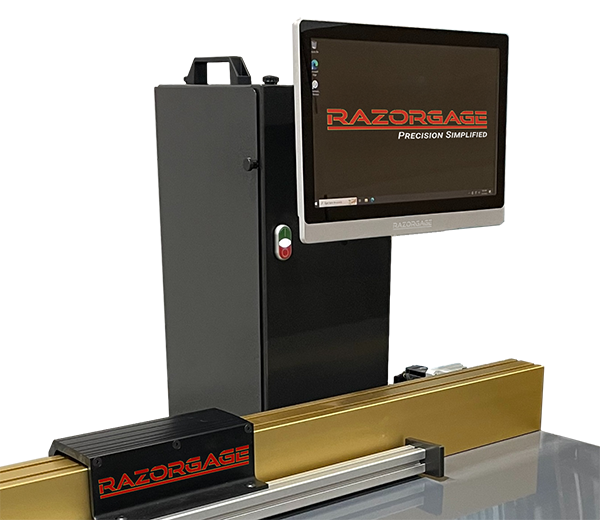
The RazorGage Positioner is designed to work as either a pusher or a stop, giving shops flexibility in how material flows through the saw. That matters because not every shop cuts the same way, and production layouts vary.
Once lengths are programmed, the positioner automatically moves to each cut dimension. The operator feeds material, executes the cut, and moves on to the next piece without resetting anything manually. That reduction in handling speeds up production and keeps measurements consistent across batches.
Repeatability is where the system really shines. It does not matter whether you cut ten parts or a thousand; they all come out the same length. In the case of shops that make cabinets, trim, or even accessories to doors or windows, such consistency is difficult to accomplish in the first place using only manual means.
Step-by-Step Workflow
The workflow with a chop saw measuring system is straightforward and easy to learn.
- First, cutlist data is imported or entered into the system. That information defines every required length before cutting begins.
- Once the job starts, the measuring system positions itself automatically to the first dimension.
- The operator feeds material to the stop or pusher and makes the cut using the chop saw.
- After the cut, the system advances to the next programmed length without manual adjustment. This cycle repeats until the cutlist is complete.
Because the positioning is automated, the operator spends less time measuring and more time cutting. That improves output while maintaining tight tolerances throughout the job.
Benefits Over Manual Measuring
Compared to manual tape measuring, automated systems deliver measurable gains almost immediately. Production cycles are faster because operators aren’t stopping to measure every cut. Material waste drops because incorrect cuts are minimized.
Cut consistency improves across the board. Parts fit together better downstream, which reduces rework during assembly. Operator fatigue is also lower since the system handles positioning instead of repetitive measuring and marking.
For shops running multiple shifts or training new operators, the system provides a level of consistency that doesn’t depend on individual skill or experience.
Ideal Shop Environments
Chop saw measuring systems work well in a wide range of production environments. Woodworking shops benefit from consistent part lengths in cabinet and furniture production. Aluminum and light metal cutting operations gain repeatability without slowing feed rates.
Mixed-material fabrication shops also see value, especially when switching between jobs with different dimensions. The ability to program lengths and move seamlessly between cuts keeps production flexible without sacrificing accuracy.
Whether you are building cabinets or manufacturing doors and windows, the system adapts to real-world shop demands without forcing a complete equipment overhaul.
Conclusion
Manual measuring has its limits. As production demands increase, so does the need for accuracy and efficiency. Chop saw measuring systems remove the guesswork from cutting and replace it with reliable, repeatable positioning.
When paired with cutlist software, the process becomes even more streamlined. Jobs are planned digitally, measurements are executed automatically, and operators can focus on safe, consistent cutting.
The RazorGage Positioner brings this workflow together in a way that’s practical, scalable, and proven on the shop floor, not just on paper.
Ready to upgrade your workflow?
Explore how a RazorGage Positioner can transform your chop saw measuring system and bring software-driven accuracy to your shop.
👉 Contact us.
FAQs
How accurate is a chop saw measuring system compared to manual measuring?
Automated systems are significantly more consistent because they eliminate tape reading errors and manual repositioning. Once programmed, each cut repeats the same dimension throughout the job.
Does cutlist software replace the operator’s role?
No. The operator still feeds material and performs the cut. The software simply removes the measuring step and reduces setup errors.
Can a measuring system be added to an existing chop saw?
Yes. These systems are designed to integrate with existing saws, allowing shops to upgrade accuracy without replacing equipment.
Is training required to use a RazorGage positioner?
Training is minimal. Most operators adapt quickly because the workflow is straightforward and mirrors normal cutting processes.