
Optimizing Material Positioning Systems for Industrial Saws | RazorGage
Industrial saw operations look straightforward from the outside: set the stop, measure the stock, and make the cut. But anyone who has worked in a production environment knows that maintaining accuracy, repeatability, and speed for hours at a time is far more demanding than it seems. Manual processes slow down workflow, introduce inconsistencies, and create fatigue over long shifts. Even a few small deviations in measurement can snowball into rework, assembly issues, or wasted material.
As woodworking, metalworking, and fabrication shops move toward tighter tolerances and higher output, the need for reliable and repeatable positioning becomes impossible to ignore. That’s why more shops are turning to RazorGage. By combining automated controls with dependable hardware, RazorGage Material Positioning System technology and miter saw automatic stop solutions help operators cut faster, cleaner, and with greater confidence. Whether you are building cabinets or manufacturing doors and windows, optimized positioning simplifies your workflow and elevates the quality of every finished part.
This blog explains how these systems work, why manual methods hold shops back, and how upgrading your material positioning setup can transform your production process.
The Challenges of Manual Material Positioning
The use of manual measuring tools has been in existence for decades, but they have limitations that impact all aspects of a production run. A tape measure does not appear difficult, yet the consistency will greatly depend on the operator, the environmental conditions, and the possibility of re-accomplishing such a measurement hundreds of times. Whenever one gets tired or has to hurry in production, then precision starts to go.
Traditional manual stops also present challenges. They shift over time, loosen under vibration, and require ongoing adjustments. Operators must check, recheck, and verify with every job. On complex cutlists, this slows down the entire workflow. Every slight misalignment compounds across parts, leading to cumulative variation that can cause assembly gaps, uneven fits, and additional sanding or trimming.
The problem becomes more significant during demanding shifts. Any system that depends on constant human focus and physical repetition invites inconsistency. Shops working with mixed-material jobs face even greater challenges, as different material types require different pressures, adjustments, or handling techniques.
Ultimately, manual positioning limits throughput and increases scrap. It forces operators to spend more time measuring and less time cutting. And in modern industrial environments, that level of inefficiency isn’t sustainable.
What Is a Material Positioning System?
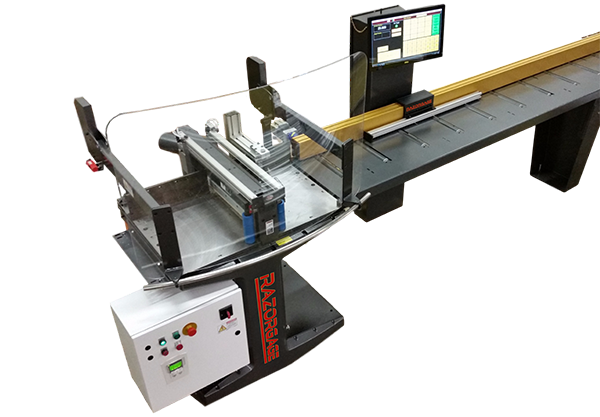
A Material Positioning System automates the process of setting the stop position for every cut. Instead of sliding a manual stop, tightening it, and measuring, operators simply enter a length into the digital interface. The stop moves automatically to the exact location needed, eliminating the guesswork of manual methods.
This system works with chop saws, miter saws, cold saws, and other industrial saws that rely on accurate material placement. RazorGage systems are designed to integrate easily into existing setups, enhancing accuracy without changing the fundamental workflow.
A digital controller ensures that positioning remains consistent across shifts and operators. Once a dimension is entered, the system repeats the same position accurately every time, without drift or the need for manual adjustments. For shops that move between repetitive runs and custom jobs, this combination of automation and flexibility makes a measurable impact on productivity.
How a Miter Saw Automatic Stop Improves Accuracy
A miter saw automatic stop transforms how operators manage length-based cutting. Instead of relying on tape measurements or visually lining up stock, the operator programs the required dimension. The stop moves directly to that length, locks in place, and stays there until the next programmed position is requested.
This controlled movement provides several critical benefits:
- Eliminates manual guesswork.
No more eyeballing the mark or sliding a stop and hoping it didn’t move while tightening. The digital control positions the stop with repeatable accuracy. - Reduces operator fatigue.
Long shifts become more manageable when operators aren’t bending and measuring repeatedly. Less strain means fewer mistakes. - Improves consistency across high-volume runs.
Even during rapid cycles, the automatic stop maintains accurate length settings without drift. - Reduces cumulative error.
Part-to-part consistency increases exponentially when the measurements are precise. This minimizes the possibility of downstream problems like gaps, ineffective fits, or rework.
At the shops where tolerances count, an automatic stop not only accelerates the production, but it also guarantees quality on each part that you cut.
Important Benefits of Automated Material Positioning.
Automated positioning of materials influences all the processes throughout the workflow. The greatest advantages are accuracy, repetition, quickness, and minimization of manual work. However, the actual payback can be realized in the long term as the material wastage reduces, throughput rises, and new operators become fully productive sooner.
Faster Throughput
Without manual measuring or stop adjustments, operators can move directly from one cut to the next. Jobs that previously took hours can be completed in a fraction of the time because the stop is always ready for the next length.
Reduced Scrap
Most scrap in industrial saw operations comes from measurement drift, inconsistent operator technique, or misaligned stop settings. Automation reduces these variables, allowing shops to use more of every board, extrusion, or bar.
Higher Consistency Across Operators
Automation levels the playing field. A new operator achieves the same accuracy as a veteran with decades of experience. For shops with multiple shifts or changing personnel, this consistency is invaluable.
Better Ergonomics
Manual stops require bending, stretching, and repeated adjustments. Automated movement eliminates these steps, improving comfort and reducing strain, particularly in high-volume production environments.
Together, these advantages reshape how operators work and how managers evaluate overall output.
Workflow Integration With RazorGage Systems
RazorGage designs its systems to support real-world production. That means improving accuracy without complicating the workflow. A material positioning system should enhance the operator’s control, not limit it.
RazorGage systems support cutlist import for automated batching. This allows operators to load a full list of lengths and cut them in sequence without manual tracking. It’s especially valuable during mixed-production schedules where lengths change frequently throughout the day.
Stop-based or pusher-style applications both benefit from RazorGage automation. Regardless of how the material is fed, the system maintains precise, consistent positions across long shifts. The stop does not sag over time, and vibration does not cause drift. Operators can trust each position to be exactly where it needs to be.
This integration simplifies complex workflows while maintaining the flexibility required for custom or high-mix jobs.
Best Applications for Automated Positioning
Automated material positioning is valuable across a wide range of industries, especially those requiring tight tolerances and repeatability.
Woodworking
Cabinet frames, drawer components, face frames, and furniture parts require precise lengths to fit together cleanly. Small variations result in visible gaps or additional trimming. Automated stops ensure accuracy across all components.
Aluminum Cutting
Window and door manufacturers rely heavily on consistent extrusions. Even slight deviations can cause alignment issues during assembly. Automated positioning provides the repeatability needed for high-quality fabrication.
Metalworking
Shops using miter saws or chop saws to cut steel, aluminum, or mixed metals benefit from reliable positioning when moving between projects or handling varied material sizes.
General Fabrication
Any operation moving between jobs with different cut requirements gains speed and accuracy with automated positioning.
If a shop relies heavily on tape measures, manual stops, or operator judgment, automation delivers immediate improvement.
Conclusion
Manual positioning can cause errors that slow production and generate undesired waste. Using a tape measure, pulling dozens of times per shift, setting stops manually, and reexamining lengths are some of the factors that cause wastes of time and unreliable outcomes. Automated material positioning systems, particularly those with a miter saw, automatically halt and eliminate those impediments.
The incorporation of RazorGage technology into the shops will provide accurate, repeatable, and efficient cutting operations that remain consistent, despite the length of the shift or the time the operator has been on the job. This added accuracy and efficiency in workflow enhances the overall productivity of the shops and minimizes the operating costs in the long run.
When your shop is willing to go beyond manual measuring and upgrade to a more reliable system of measuring, RazorGage offers systems, which have been customized to be durable, accurate, and in the real world.
Discover the Razorgage RG3 and RGxT, guaranteed to improve your shop’s performance.
FAQs
Why should shops upgrade to a material positioning system?
Because it eliminates manual measuring and provides consistent accuracy across every shift. A material positioning system reduces scrap, speeds up production, and ensures repeatable results for all operators.
How does a miter saw automatic stop improve workflow?
It moves directly to programmed lengths, reducing operator adjustments and cutting time. This keeps production fast and consistent.
Is automated positioning suitable for mixed production schedules?
Yes. Automated controls work well with repetitive runs and custom jobs.
Which industries benefit the most?
Woodworking, aluminum fabrication, and metalworking shops see the greatest improvements in accuracy and throughput.