
What Makes Repeatable Cutting Difficult in Furniture Manufacturing?
Scrap rarely announces itself. A part cut a sixteenth of an inch off looks fine on the bench, and then a door doesn’t sit flush three stations down the line. Multiply that by a run of two hundred, and you have a real line item on the cost sheet. Those parts weren’t cut badly. They were cut inconsistently, and that’s a different problem with a different fix.
A saw measuring system removes the guesswork from where material lands before the blade drops. RazorGage builds that equipment for shops where cut lengths have to be held, whether you build furniture, cabinets, or doors and windows. Here is where repeatability usually breaks down and what corrects it.
Why Repeatable Cutting Matters
A cabinet box only works when the sides, top, and bottom all agree. The same goes for a furniture frame, a table or desk top, and the stiles and rails used to make face frames for cabinets or door parts. Consistent dimensions are not a luxury. They let parts come off the bench and go together without clamps forcing them into place.
When dimensions slip, the cost spreads out. Parts get re-cut, burning material and machine time. The work behind them is delayed. And when the next batch doesn’t come out the same as the last, none of the components fit together. Shops that hold tight tolerances between shifts and batches spend far less time troubleshooting later.
Where Repeatability Actually Breaks Down
Most cutting errors start well before the blade moves. They start with how the material got positioned.
Tape measures are a bigger culprit than most people admit. The hook wears, the blade kinks, and two operators read the same line differently. Manual stops get bumped, and nobody notices until forty parts later. And material that isn’t held firmly against the fence can shift during the cut, which is nearly impossible to catch by eye.
Then there’s the human side. Measuring and repositioning material several hundred times a day is dull, repetitive work, and the mistakes cluster at the end of a shift when everyone is trying to finish. Production pressure doesn’t create accuracy problems so much as it exposes them.
The Limits of Tape and Fixed Stops
Manual measuring asks an operator to verify a dimension and reposition material for every single cut. On a short run of one-offs, that’s fine. On a run of fifty identical parts, you’ve created fifty chances to be off by a hair, and every one of them depends on the same person paying the same attention.
Fixed stops solve the speed problem and create a flexibility problem. Every new cutlist means setup work, and shops that change jobs often spend more time resetting stops than cutting. Even careful operators can’t fully control repeatability when the process rests on human judgment at every step. The harder you push volume, the more obvious those limits become.
What a Digital Saw Measuring System Changes
Digital positioning replaces eyeballing with a number. The operator sets a target length, the system moves to it, and when that part comes up again, the setting comes back exactly the same. No re-measuring, no interpretation, no drift between the first part of a run and the last.
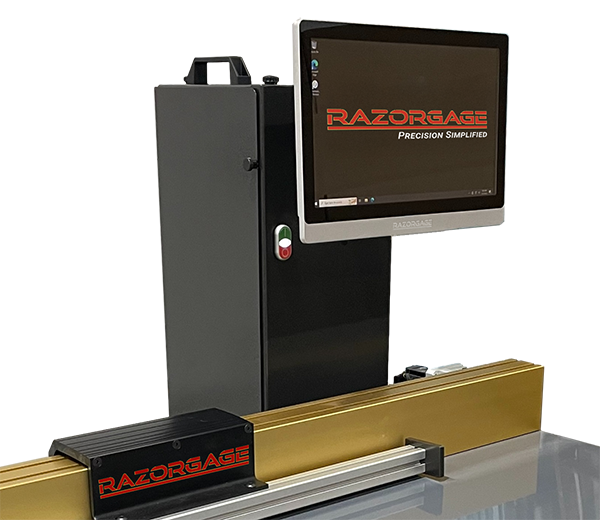
Stored lengths make changeovers quicker too, which is worth a lot in shops bouncing between custom work and repeat production. If you’re still on tape measures and manual stops, the RazorGage digital saw measuring system is the sensible entry point. The RGxT digital saw stop gives you accurate, repeatable positioning without changing how your people feed the saw.
Saw Positioning Systems Do the Physical Work
Accuracy isn’t only a number on a display. Something has to put the material at that length, consistently, part after part. That’s the job of a saw positioning system, and it’s where automated setups pull ahead of manual handling.
The RazorGage RG3 Automatic Saw Measuring System runs as an automatic pusher or as a measuring stop, and it works with chop saws, automatic upcut saws, downcut saws, drill presses, and other equipment. That matters for shops that aren’t replacing their saws. When the RG3 is integrated with RazorGage’s optimizing saw systems, options like programmable saw stops, AutoList optimization software, and label printing become available. These features come from the RazorGage positioner and software, not from the saw.
Length Stop Measuring Systems and the Reference Point Problem
Every cut is measured from a reference point, and a length stop measuring system makes sure every cut is measured from the same one. When the stop doesn’t move and isn’t misread, parts come out the same length every time, and rework drops.
Digital and automated stops go one step further: no one has to read a scale at all. The right setup for your shop depends on your material, equipment, job requirements, and volume. There is no one-size-fits-all, and the most automated option is not always the best one.
Choosing the Right RazorGage System
Where you start should follow what’s actually costing you money.
If tape measures are the bottleneck, the RGxT digital saw stop is the direct replacement. If you want automated positioning on equipment you already own, the RG3 Automatic Saw Measuring System works with a wide range of saws and drill presses as either an automatic pusher or a length stop. If labor is the constraint, the APS automated optimizing saw system lets one person feed the saw and offload finished parts. And if yield on expensive stock is the real problem, the RazorOptimal Optimizing Saw System scans material for defects and optimizes parts to fit the defect-free areas, minimizing waste.
Different entry points, same underlying fix: material positioned by a machine instead of by eye.
The Bottom Line
Repeatable cutting is hard when it depends on tape measures, moving stops, and hundreds of small decisions every shift. Digital measuring and automated positioning remove most of that variation, and the result is parts that fit the first time.
RazorGage builds for shops that want accuracy built into the process, not dependent on who is running the saw that day. The right investment depends on your equipment, material costs, and production needs, but the result is the same: more consistent output and a line that doesn’t stall every time the cutlist changes.
FAQs
What causes inconsistent cut lengths?
Manual measuring, material shifting before the blade engages, and fatigue during long shifts.
Does digital positioning replace the operator?
No. It handles length positioning and repeatability. Operators still control the feed and the cut.
Will RazorGage work with my existing saw?
Yes. The RG3 runs with chop saws, upcut saws, downcut saws, drill presses, and more.
Where should a small shop start?
The RGxT digital saw stop, as a direct replacement for tape measures and manual stops.