
Why Should Manufacturers Upgrade to Automated Positioning Systems?
Precision matters when you are producing the same parts over and over. A small measuring error may not seem serious on one piece, but across hundreds of cuts, it can mean wasted material, rework, and lost production time. Whether you are building cabinets or manufacturing doors and windows, manual measuring and feeding can make consistency harder to maintain.
That is where automated positioning systems can make a real difference. An automatic pusher system can position material accurately and repeatedly, while programmable stops and integrated software reduce the amount of measuring and adjustment required from the operator. The goal is not to automate every task simply because you can. It is to remove the repetitive work that slows production and creates avoidable errors.
The Positioning Challenges in Manufacturing
Manual positioning works. There is no question about that. For smaller shops or occasional production, an operator can measure a part, set a stop, make the cut, and repeat the process. The problem appears when that same process has to be repeated hundreds of times.
Manual stops require regular adjustment. Operators have to measure dimensions, move the stop, check the setting, and make sure the material is positioned correctly before cutting. Even experienced operators can lose time doing this throughout a long production day. Fatigue adds another variable. After hours of repetitive measuring and handling, small mistakes become easier to make. A part can be cut slightly short or long, and that error may not become obvious until it reaches assembly.
Material waste is another concern. A single miscut might not hurt much. A series of them can. Traditional feeding systems can also become difficult to manage when production changes frequently. Custom orders, multiple dimensions, and different material lengths require constant adjustments. What worked efficiently for one job may slow the next one down.
What Are Automated Positioning Systems?
Automated positioning systems are designed to take much of that repetitive measuring and positioning work out of the operator’s hands. An automated pusher can move material to a programmed position, helping the operator achieve repeatable cut lengths without manually measuring every piece. Depending on the system, the equipment can also work as a programmable saw stop or integrate with cutting equipment to create a more complete production workflow.
An automated push feed saw setup takes this concept further by combining controlled material positioning with a saw. The positioning system handles where the material needs to go, while the saw performs the actual cut.
This distinction matters. The positioning equipment and the saw are not the same thing. A positioner measures and moves material into position. An optimizing saw system can combine the saw, positioner, and software into a coordinated workflow.
An automatic pusher and stop system saw setup can therefore provide both positioning and repeatable stopping, depending on the configuration. This makes automated systems useful across different types of woodworking production rather than limiting them to one application.
How RazorGage Approaches Automated Positioning
RazorGage builds positioning equipment around a simple idea: make repetitive cutting more accurate without making the operator’s job unnecessarily complicated. The RG3 Chop Saw Measuring System, for example, can function as either an automatic pusher or a saw stop. That gives shops flexibility based on how they work and what the job requires.
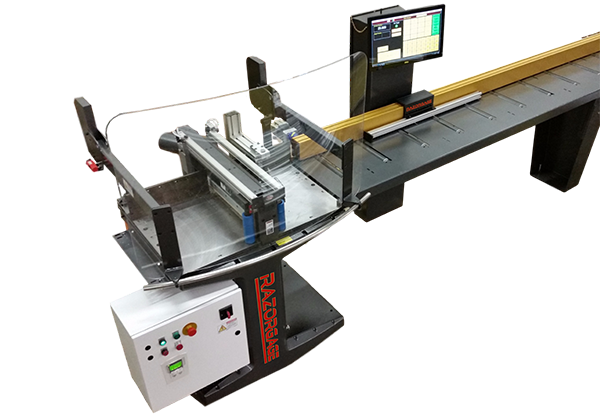
For operations that need more active material handling, the APS Auto Pusher System allows one operator to feed and offload material efficiently. Instead of constantly measuring and repositioning stock by hand, the system handles the positioning work. This can be particularly useful when production involves many repeated dimensions. The operator can focus on loading, cutting, and managing the workflow instead of spending the entire shift checking measurements. The result is a more consistent process without removing the operator from the equation.
From Manual Saws to Automated Cutting Systems
There is still a place for manual saws. Not every shop needs full automation, and not every production run justifies it. The difference comes down to volume, repeatability, and how often measurements change. A chop saw measuring system can add positioning control to a chop saw without requiring a shop to completely change its production process. The operator still manages the material and cutting workflow, but the measuring and positioning process becomes more repeatable.
For operations using an Upcut saw for sale or an existing upcut saw, adding an appropriate positioning system can provide another level of control. The saw remains responsible for cutting, while the positioning equipment handles material placement.
RazorGage also offers the Cyclone 600 Upcut Saw. Its industrial design incorporates a direct-drive motor that glides on machine tool-grade, recirculating ball linear bearings, providing ultimate durability. The Cyclone 600 is designed to cut wood up to 20 inches wide. Its smooth cutting motion, combined with proper material clamping, helps produce clean and accurate results. The important point is that these functions work together. The blade does not simply push the stock into position. RazorGage systems use manual or automatic clamps to hold material securely during the cutting process.
Where Automation Starts Reducing Waste
One of the strongest reasons to automate positioning is waste reduction in manufacturing. Better positioning helps prevent basic measuring mistakes. But optimizing systems can go beyond simply placing material at the correct dimension.
The RazorOptimal Optimizing Saw System can scan material for defects and determine how cuts can be arranged to make better use of available stock. Instead of treating every board as perfect, the system accounts for usable and defective sections when planning cuts. That can be especially valuable when material costs are significant. Less wasted material means fewer boards going into the scrap pile. It also means operators spend less time dealing with replacement pieces and remaking parts that were cut incorrectly. Waste reduction does not come from one feature alone. It comes from making better decisions throughout the cutting process.
Faster Production Without Sacrificing Accuracy
Automation is often associated with speed, but speed by itself is not the goal. Cutting faster does not help if the parts need to be checked, corrected, or remade afterward. The real benefit comes from combining faster positioning with repeatable accuracy. Servo-driven positioning can move material into the programmed location without the operator manually measuring each part.
That makes a difference during long production runs. The same dimensions can be repeated across multiple operators and shifts. Production becomes less dependent on one experienced employee remembering exactly how every setup was handled.
This is one reason automated miter saw systems can be useful for manufacturers producing frames, trim, and other components where angle accuracy and repeatability matter. RazorGage AngleMaster provides automated and semi-automatic angle cutting options, allowing shops to use the level of automation that fits the job.
Safety and Material Handling
Automation can also reduce unnecessary manual handling around cutting equipment. Operators still need to load and manage material, but automated positioning can reduce the amount of repetitive movement required to measure, push, reposition, and reset stock. RazorGage equipment also incorporates safety features appropriate to the equipment, including 2-hand anti-tie down buttons, electronic braking, and the ability to manually crowd the material to the fence.
These features are part of a broader approach to making production more controlled. Automation should not mean removing the operator’s awareness from the process. It should make repetitive tasks easier to manage while keeping the operator in control.
More Than an Automatic Pusher
It is easy to think of an automatic pusher as simply a machine that moves material. In practice, the value comes from how that positioning capability fits into the larger workflow. A shop might use an RG3 as a programmable stop for one type of production. Another operation may use it as an automatic pusher. A larger manufacturer may combine positioning equipment with an upcut saw, optimization software, and other automation.
That is where an automated saw system becomes different from simply buying a new saw. The saw is one part of the process. Positioning, material handling, optimization, and operator workflow determine how efficiently the complete system performs. RazorGage gives manufacturers options instead of forcing every shop into the same setup.
Where Automated Positioning Systems Make the Most Sense
Automated positioning can benefit a wide range of manufacturing environments. Door and window manufacturers can use repeatable positioning for components that need consistent dimensions across large production runs. Custom cabinet shops can benefit when producing doors, drawers, frames, and other components with repeated dimensions. Mixed-material shops may also benefit from controlled positioning when cutting wood, aluminum, composites, or other materials, provided the selected equipment is appropriate for the application.
High-volume woodworking operations have perhaps the clearest use case. When hundreds or thousands of parts need consistent positioning, reducing manual measuring can save substantial production time. The right solution depends on the work. A smaller shop may need a measuring table or programmable stop, while a larger operation may benefit from a complete optimizing saw system.
Conclusion
Manufacturing does not become more efficient simply because a shop buys more automation. The equipment has to solve a real production problem. Automated positioning systems address one of the most repetitive parts of cutting: measuring, positioning, and resetting material. They can improve consistency, reduce operator fatigue, limit avoidable waste, and help shops produce more parts without sacrificing accuracy.
RazorGage approaches automation as a flexible system rather than a one-size-fits-all upgrade. From the RG3 and APS Auto Pusher System to the Cyclone 600, AngleMaster, RazorOptimal, and Caliper Measuring Table, different solutions address different production needs.
For manufacturers looking to move beyond manual measuring and improve the way material moves through the shop, automation can be a practical next step.
FAQs
What Is an Automatic Pusher System?
An automatic pusher system positions material to programmed dimensions, reducing repetitive manual measuring and improving cut-to-cut consistency.
Does Automation Eliminate the Need for Operators?
No. Operators still load material, monitor production, and manage the workflow. Automation handles repetitive positioning tasks.
Can Positioning Systems Work with Different Saws?
Yes. Depending on the configuration, RazorGage positioning systems can integrate with chop saws, upcut saws, and miter saws.
Does Automation Help Reduce Material Waste?
Yes. Accurate positioning reduces miscuts, while optimizing systems can further reduce waste by planning cuts around usable material.
Ready to Upgrade Your Cutting Process?
If repetitive measuring is slowing production, it may be time to look beyond the saw itself. RazorGage offers automated positioning systems designed to improve accuracy, throughput, and material use across real-world manufacturing environments.
Explore RazorGage’s positioning, measuring, and cutting solutions at RazorGage