
Why Do Custom Cabinet Shops Need Automated Measuring Systems?
Custom cabinet work leaves very little room for measurement errors. Doors, drawer fronts, frames, panels, and trim pieces all need to fit together properly, and a small mistake at the saw can create problems later in assembly. When every part is measured and positioned manually, accuracy depends heavily on the operator doing the same thing correctly every time.
That becomes harder as production increases. Manual tape measuring takes time, traditional stops require frequent adjustments, and operator fatigue can lead to miscuts and wasted material. Length stop measuring systems give cabinet shops a more controlled way to measure and position material, helping improve repeatability without forcing every job into the same production process.
The Measurement Challenges in Custom Cabinet Shops
Manual measuring seems straightforward. Measure the part, mark the material, position it at the saw, make the cut, and repeat. The problem is doing that hundreds of times in a busy shop. Even experienced operators can make mistakes. A measurement may be slightly off, a stop may not be locked in the right position, or an operator may simply lose focus after repeating the same task for several hours.
These small errors add up.
A single bad cut might only waste one piece of material. Across a full cabinet order, though, those mistakes can create a surprising amount of scrap. The shop also loses time remaking parts, checking dimensions, and dealing with delays during assembly. Traditional manual stops can create another problem. They work well when the same dimension is being cut repeatedly, but custom cabinet work often involves several different part sizes. Constantly moving and resetting the stop slows the operator down. For shops handling custom orders, the goal is not simply to cut faster. It is to make the correct cut consistently while keeping setup time under control.
What Are Automated Measuring Systems?
Automated measuring systems replace much of the guesswork involved in manual positioning. Instead of relying on a tape measure and manually adjusting the stop for every dimension, the system can position material to a programmed length with repeatable accuracy.
An automatic length measuring system uses controlled positioning to help operators move quickly from one dimension to another. This is especially useful when a cabinet order includes many different part lengths.
Servo-driven positioning is another important part of the process. A servo length stop system can move to the required position accurately, allowing the operator to spend less time measuring and resetting the equipment. Programmable saw stops also make job changes easier. Rather than manually calculating and setting every new dimension, the operator can work from programmed measurements and repeat them as needed.
These systems can be used with different cutting equipment, including upcut saws and miter saws, depending on the application. The important point is that the measuring and positioning system supports the cutting process. It does not turn every saw into a fully automated optimizing saw system.
Key Features of RazorGage Systems
RazorGage offers several solutions designed around different production needs. The right setup depends on the type of material being cut, production volume, and how much automation the shop actually needs.
RG3 Automatic Saw Measuring System
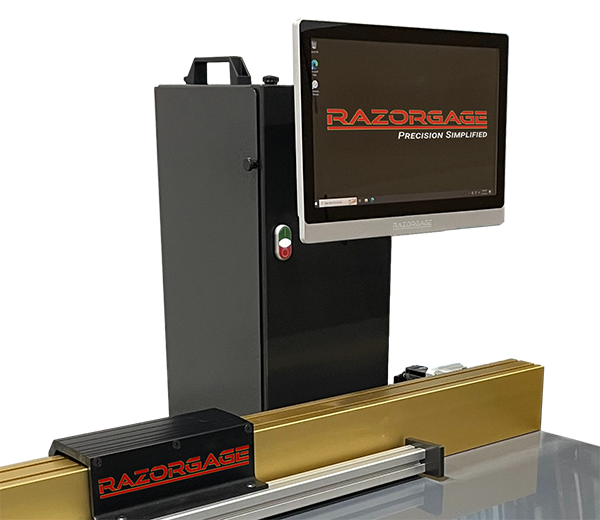
The RG3 Automatic Saw Measuring System provides automated positioning for applications such as chop saws, upcut saws, and drill presses. It helps operators quickly position material to the required length instead of relying on repeated manual measurements. For shops handling a steady flow of different dimensions, that repeatability can make a major difference in daily production.
APS Auto Pusher System
The APS Auto Pusher System takes material handling a step further. It is designed to help one operator feed and offload parts efficiently, reducing the amount of manual handling required during production. That can be valuable for shops looking to improve throughput without simply adding more labor to the process.
RazorOptimal Optimizing Saw System
The RazorOptimal Optimizing Saw System focuses on optimizing material usage as part of the cutting process. The system can scan material for defects and determine cutting strategies that help reduce unnecessary waste. This is different from simply adding an automatic stop to a saw. An optimizing saw system combines cutting, positioning, and optimization functions to address material usage and production efficiency together.
AngleMaster Semi-Automatic Miter Saw
Cabinet joints often require accurate angle cuts, and this is where the AngleMaster provides another option. Its semi-automatic approach gives operators controlled positioning while still allowing hands-on control when the job requires frequent angle changes. That makes it useful for custom work where full automation may not always be the most practical choice.
Caliper Measuring Table
Not every shop needs a fully automated production setup. The caliper measuring table provides an affordable way to verify cut lengths and improve measurement accuracy. For smaller operations or shops that are still building toward automation, a measuring system like this can provide a practical step forward.
Benefits of Automating Material Feeding
Automation is not only about making a machine move faster. It is about removing repetitive tasks that create opportunities for mistakes.
One of the biggest advantages is waste reduction in manufacturing. Better positioning and, where applicable, material optimization can help reduce miscuts and make better use of expensive stock. Throughput can improve as well. Servo-driven positioning allows operators to move between dimensions without repeatedly reaching for a tape measure, calculating measurements, and manually resetting a stop.
Consistency is another major benefit. A programmed position does not change because one operator measures slightly differently from another. That helps maintain more consistent production across shifts. Material handling can also become easier. Automated positioning and feeding systems reduce some of the repetitive movement involved in moving parts through the cutting process. Operators can spend more time managing the workflow instead of constantly measuring and repositioning stock by hand.
The benefits of automating material feeding become particularly noticeable when the shop is processing many similar parts or running multiple jobs throughout the day.
How Automated Systems Transform Cabinet Shops
Automation can change the pace of a custom cabinet shop without taking the craftsmanship out of the process.
Faster setup changes mean operators can move between different cabinet dimensions with less interruption. That matters when a custom order contains dozens of unique parts rather than one repeated size. Rework can also decrease. When parts are positioned consistently, there is less opportunity for measurement errors to move downstream into assembly. That does not mean automation eliminates every production problem. Material quality, saw setup, blade condition, operator decisions, and overall workflow still matter. Automation simply removes one major source of variability from the process.
For growing shops, this can also create room to increase production without sacrificing the accuracy customers expect. Instead of solving every increase in workload by adding more manual measuring and labor, the shop can build a more repeatable process. The result is a workflow that is easier to manage and easier to scale.
Manual vs. Automated Saw Stops
Manual stops still have their place. For simple jobs with only a few dimensions, a skilled operator may be able to work efficiently with a traditional setup. The difference becomes clearer when production involves many dimensions, repeated batches, or frequent job changes.
A Miter saw automatic stop can help automate positioning for applicable miter saw operations, while a programmable saw stop can provide repeatable positioning based on programmed dimensions. The important distinction is that the stop handles positioning. It does not automatically mean the entire cutting process is automated.
The same applies to upcut saws. An automated upcut saw can improve production efficiency, but an optimizing saw system goes beyond the saw itself by combining equipment with positioning and software designed for a broader production workflow. Understanding that difference helps shops choose automation based on what they actually need instead of paying for features that may not improve their operation.
Ideal Applications for Automated Measuring Systems
Automated measuring systems can make sense for a wide range of woodworking operations.
Custom cabinet shops can use them for doors, drawer components, frames, panels, and other repeat-cut applications. Door and window manufacturers can also benefit when consistent dimensions and high production volumes make manual positioning inefficient. They can also work well in mixed-material operations where shops process wood, aluminum, composites, or other materials, depending on the equipment configuration.
For high-volume woodworking operations, repeatability becomes even more important. When the same process is repeated throughout a shift, small improvements in setup time and measurement accuracy can have a meaningful effect on overall production.
The key is matching the level of automation to the workflow. Not every shop needs a completely automated line. Sometimes an automatic measuring system is enough. Other operations may benefit from feeding, positioning, and optimizing capabilities working together.
Conclusion
Precision is not optional in custom cabinet manufacturing. A part that is off by a small amount can create problems that show up much later, after more labor and material have already been invested.
RazorGage approaches automation by giving shops different ways to improve measurement, positioning, feeding, and optimization. From the RG3 Automatic Saw Measuring System to the APS Auto Pusher System and RazorOptimal Optimizing Saw System, each solution addresses a different part of the production process. It’s not about automation for the sake of automation. It’s developing a process that will allow for more control, repeatability, waste elimination, and production flow over the operation. From cabinet construction to door and window production, the proper measuring and positioning tools can convert difficult manual tasks into a more reliable production process.
Ready to Improve Your Measuring and Cutting Workflow?
Manual measuring might be slowing production or generating unnecessary scrap, so it may be time to consider a more repeatable measuring method. RazorGage offers solutions ranging from automated measuring and positioning to complete optimizing saw systems, so shops can choose the level of automation that fits their workflow. Explore automatic length measuring system solutions and see how RazorGage can help your shop improve accuracy, efficiency, and production consistency.
Visit RazorGage to explore the available solutions:https://razorgage.com/
FAQs
Why Should a Cabinet Shop Automate Measuring?
Automated measuring reduces repetitive manual measurements and helps operators position material consistently. It can also reduce setup time, errors, and material waste.
What Is a Servo Length Stop System?
A servo length stop system uses controlled motorized positioning to move a stop to the required measurement. This allows operators to repeat dimensions accurately without manually measuring each part.
Can Automated Measuring Systems Work with Upcut Saws?
Yes. RazorGage measuring systems can be configured for applications involving upcut saws. The measuring system handles positioning, while the saw performs the cutting operation.
Does Every Cabinet Shop Need a Fully Automated Saw System?
No. Smaller or custom-focused shops may benefit from automated measuring or positioning alone. Higher-volume operations may gain more from combining positioning, feeding, and optimizing capabilities.