
What Are the Benefits of Automating Material Feeding in Cutting Processes?
Material feeding doesn’t get talked about enough. Most shops focus on the saw, the blade, maybe the cut quality. But the way material gets to the blade? That’s where a lot of inefficiency hides. Manual feeding feels normal because it’s familiar, but it quietly slows everything down.
As production picks up, those small delays start stacking up. Operators get tired. Measurements drift. Cycle times stretch. This is where an automatic positioner system paired with an automated upcut saw starts to change things. Not in a flashy way. Just steady, repeatable improvement where it actually matters: output, accuracy, and consistency.
The Limitations of Manual Material Feeding
Manual feeding works… until it doesn’t.
Every cut depends on the operator positioning the material correctly. That means measuring, aligning, holding, adjusting. Over and over again. It’s not just time-consuming, it’s inconsistent by nature.
In high-volume environments, this creates real problems. Cycle times slow down because each piece requires attention. Accuracy depends heavily on the operator. Even experienced workers can drift slightly over long shifts. And those small errors? They compound.
Fatigue is another issue. Holding material steady near a cutting area all day isn’t easy. As fatigue sets in, mistakes increase. Safety risks go up, too.
Even if you’re running a high-quality industrial upcut saw or an upcut saw for wood, manual feeding becomes the bottleneck. The machine might be capable of more, but the process around it holds it back.
What is Automated Material Feeding?
Automated material feeding replaces manual positioning with controlled, repeatable movement. Instead of relying on an operator to measure and align each cut, the system does it consistently.
This is typically done through an automatic saw system that includes a positioning system or pusher. The material is moved to exact cut positions based on programmed inputs or cutlists.
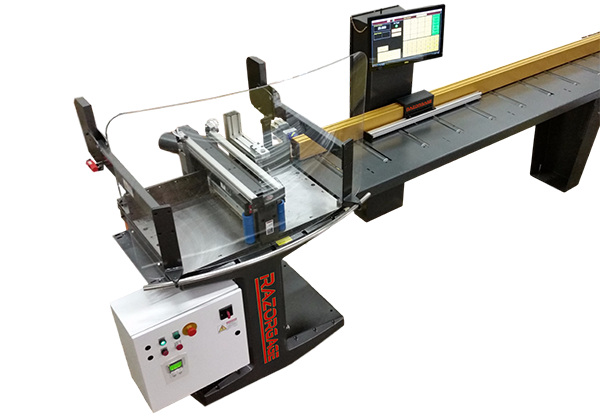
When paired with systems like the RazorGage Cyclone 600 Upcut Saw, the process becomes more stable. Material moves precisely. Cuts happen consistently. There’s no guesswork in alignment.
It’s important to understand this isn’t just about speed. It’s about control. Every movement is deliberate. Every position is repeatable. That’s what changes the outcome.
How Automatic Positioning Systems Improve Accuracy
Accuracy is where automation shows immediate results. With manual feeding, measurements rely on human input every time. Even small inconsistencies can lead to variation across parts. Over a long run, those differences add up fast.
Automatic positioning systems remove that variability. Once the system is set, it delivers the same positioning again and again. There’s no remeasuring. No visual estimation. Just consistent placement.
This becomes especially valuable when working with an upcut miter saw or any setup where precision matters across multiple cuts. Systems that include features like a miter saw’s automatic stop further support repeatability by ensuring material stops at the exact programmed point.
Another key factor is material holding. RazorGage saw systems use clamps, manual or automatic, to secure material during cutting. The clamps hold the stock firmly in place. That stability, combined with smooth cutting motion, is what produces clean, accurate results. Not blade pressure. Not operator force. The result is simple: accuracy becomes system-driven, not operator-dependent.
Productivity Gains with Automated Upcut Saw Systems
Productivity isn’t just about cutting faster. It’s about removing delays. Manual feeding introduces pauses between every cut. Position, check, adjust, cut. Repeat. Those pauses don’t seem like much individually, but over a full shift, they add up to lost time.
An automated upcut saw system setup eliminates most of that downtime. Material feeds continuously. Cuts happen in sequence. There’s no need to stop and reset for every piece.
This changes how operators work, too. Instead of being tied to feeding material, they can monitor the system, handle other tasks, or manage workflow more efficiently. For high-volume operations, the difference is noticeable. Output increases without adding more labor. The system simply uses time better. And it’s not limited to large facilities. Even mid-sized shops see gains because the process becomes more consistent. Less downtime. Fewer interruptions. More usable parts per shift.
Safety Improvements in Automated Feeding Systems
Manual feeding puts operators close to the cutting area. That’s just part of the process. But it also increases risk. Automated systems reduce that interaction. Material moves through the cutting process without constant handling. Operators don’t need to position stock near the blade for every cut.
This reduces exposure to potential hazards. It also lowers fatigue, which plays a big role in workplace safety. Tired operators are more likely to make mistakes. Automation helps avoid that.
Systems like the RazorGage Cyclone 600 Upcut Saw are designed with safety in mind. Features such as 2-hand anti-tie-down buttons, electronic braking, and the ability to manually crowd the material to the fence all work alongside automated feeding, not in conflict with it. The goal isn’t just to make cutting faster. It’s to make it safer and more controlled over long shifts.
Durability and Design: Why It Matters in Automated Systems
Automation only works if the equipment can handle consistent use. That’s where machine design becomes important.
The RazorGage Cyclone 600 Upcut Saw stands out here. The industrial design incorporates a direct-drive motor that glides on machine tool-grade, recirculating ball linear bearings, providing ultimate durability. This reduces vibration and wear over time.
Many other saws rely on swing-arm motion. That design introduces more vibration, which leads to faster wear and less consistent performance.
In automated environments, where the system runs continuously, that difference matters. Less vibration means smoother operation. Smoother operation means better cut quality and longer machine life. It’s not something you notice immediately. But over time, it shows up in maintenance, downtime, and overall reliability.
Integration with Advanced Cutting Systems
Automation becomes more powerful when it’s part of a larger system. Material feeding, cutting, and positioning don’t need to operate separately. When integrated, they create a more efficient workflow.
For example, the RG3 RazorGage positioner is part of the AngleMaster Automated Angle Cutting System. This allows shops to handle both straight and angled cuts within a consistent process.
It’s also important to separate components correctly. Features like programmable saw stops, optimization software, and label printing belong to positioning systems like the RG3, not the saw itself. When combined, though, they create a more complete optimizing solution.
This kind of integration supports better planning too. Cutlists can be optimized. Material usage improves. Workflow becomes more predictable. At that point, automation isn’t just a feature. It becomes part of how the shop operates day to day.
Ideal Applications for Automated Material Feeding
Not every shop needs automation right away. But many reach a point where manual processes start holding them back.
High-volume woodworking operations benefit the most. So do cabinet shops and manufacturers handling repeatable cuts throughout the day.
Whether you are building cabinets or manufacturing doors and windows, consistency matters. When production increases, manual feeding struggles to keep up.
Shops using an upcut saw for wood in repetitive tasks often see the biggest gains. The more consistent the workflow, the more value automation brings.
It’s also a strong fit for facilities looking to scale. Instead of hiring more labor to increase output, automation allows existing systems to do more.
Conclusion
Manual feeding gets the job done. But it comes with limits, slower cycles, inconsistent results, and increased risk over time.
Automating material feeding changes that. It brings consistency into the process. It reduces dependency on operator input. It improves both speed and accuracy without overcomplicating the workflow.
An automatic positioner system combined with an automated upcut saw isn’t just about upgrading equipment. It’s about making production more predictable.
And in a shop environment, predictability is what drives efficiency.
Ready to Improve Your Cutting Workflow?
If manual feeding is slowing things down, it might be time to rethink the process. Explore how a complete automatic saw system with RazorGage solutions can improve accuracy, efficiency, and safety in your operation.
Visit RazorGage.
FAQs
How Does an Automatic Positioner System Improve Cutting Accuracy?
An automatic positioner like the RazorGage RG3 positions material consistently for every cut, removing manual measurement errors. This ensures repeatability across long production runs and reduces variation between parts.
Is Automation Only Useful for Large Shops?
Not necessarily. Even mid-sized shops benefit from improved consistency and reduced downtime, especially when handling repetitive cutting tasks.
Does Automated Feeding Replace Operators Completely?
No. Operators still monitor the system and manage workflows. Automation reduces manual handling, not overall involvement.
Can Automated Systems Handle Different Cut Types?
Yes, especially when integrated with positioning systems and solutions like RazorGage setups. They can support both straight and angle cutting workflows efficiently.