
How Can Door and Window Manufacturers Improve Miter Cut Accuracy?
Precision matters when you are building doors and windows. A small error in a miter cut can create visible gaps, poor-fitting joints, sealing problems, and extra work during assembly. When those mistakes happen across dozens or hundreds of parts, the cost adds up quickly. That is where the RazorGage AngleMaster can make a real difference. Instead of relying entirely on manual measuring and angle adjustments, shops can use controlled positioning and repeatable cutting processes to improve accuracy. The goal is not to remove the operator from the process. It is to give the operator better control over the work.
The Accuracy Challenges in Miter Cutting
Miter cutting looks straightforward until production volume increases. Cutting one frame accurately by hand is one thing. Repeating that same result throughout an entire production run is another. Manual angle saw machines depend heavily on operator skill. The material has to be measured, positioned, adjusted, and checked before cutting. If an angle is slightly off, that error can carry into the next stage of production.
Even experienced operators deal with this. Switching between different angles or part sizes creates more opportunities for mistakes. Fatigue and repeated measuring can also slow production and make results less consistent from one shift to another. The problem becomes even more noticeable when several components have to fit together. A small angle difference can create gaps at the joint or force an assembler to make adjustments that should not have been necessary in the first place.
Material waste is another concern. A bad cut does not just cost the piece of material. It costs the time spent measuring, cutting, handling, and sometimes assembling that part before the mistake is discovered. Traditional cut lists can add another layer of inefficiency. When operators have to manually work through long lists and determine the best cutting sequence themselves, material can be used less efficiently than it could with an optimized process.
What Is the RazorGage AngleMaster?
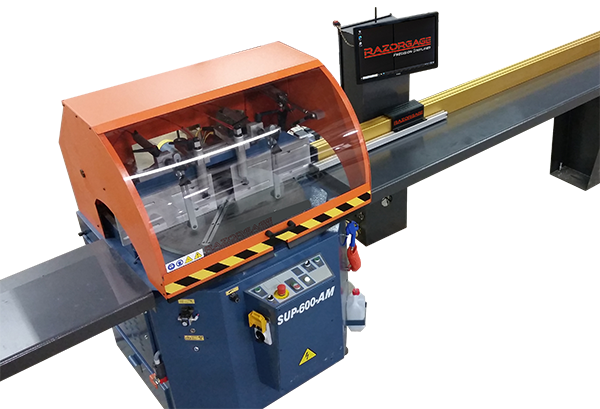
The RazorGage AngleMaster is designed for shops that need accurate angle cutting without making every job dependent on manual setup. It provides a semi-automatic angle cutting workflow that helps operators position material accurately and repeat settings without starting from scratch each time. That makes it useful for production environments where angles and part requirements can change throughout the day.
The system can also support automatic operation when equipped with the AngleMaster Auto90 Package. The package is not standard with AngleMaster saw systems. It adds the ability to run qualifying 90° groups automatically while allowing jobs with varying angles to remain in semi-automatic operation. That distinction is important. Not every job benefits from full automation.
For a run containing parts that all use a 90° angle, automatic positioning can improve production speed. When a cut list contains multiple angles, semi-automatic operation gives the operator more control and allows angle drops to be cleared when necessary. The result is a hybrid approach rather than forcing every job into the same production method.
How RazorGage Improves Miter Cut Accuracy
Accurate cutting starts with accurate positioning. A high-quality saw cannot compensate for material that was measured or positioned incorrectly before the cut. RazorGage uses controlled positioning to reduce the guesswork involved in repeated cuts. Digital settings make it easier to return to the required position instead of relying on tape measurements and visual estimates.
Material holding is just as important. RazorGage systems use clamps, either manual or automatic, to hold the material securely during cutting. The material is not simply expected to move into position because of blade pressure. That controlled setup helps maintain consistency from one part to the next. It also helps operators produce repeatable results without constantly stopping to recheck measurements.
For shops handling door and window components, that consistency can have a direct effect on assembly. Better-fitting parts mean fewer adjustments later.
Role of RazorGage Cutting and Positioning Solutions
The saw is only one part of an efficient cutting operation. RazorGage offers several solutions that can work together depending on the needs of the shop.
AngleMaster Automated Miter Saw System
The AngleMaster provides a dedicated solution for accurate angle cutting. Its hybrid automatic and semi-automatic workflow makes it suitable for both repetitive production and jobs that require more operator control. It can be particularly useful for frames, sashes, muntins, and other components where accurate angles are critical to final fit.
RazorGage Cyclone 600
The RazorGage Cyclone 600 is an Upcut Saw designed for demanding production environments. Its industrial design incorporates a direct drive motor that glides on machine tool-grade, recirculating ball linear bearings, providing ultimate durability. This design helps reduce vibration and supports long-term machine performance. The Cyclone 600 should be considered as the saw itself, rather than being confused with a complete optimizing saw system.
RG3 Chop Saw Measuring System
The RG3 can serve as a measuring and positioning solution, with configurations that allow it to function as an automatic pusher or saw stop. When integrated into an optimizing saw system, it can help operators position material quickly and repeatably. This is different from the cutting function of the saw itself.
RazorOptimal Cut List Optimization Software
Cut list optimization can have a major impact on material usage. RazorOptimal software can analyze the material requirements and optimize how parts are arranged on available stock. This reduces the amount of manual planning required and can help shops get more usable parts from their material. For manufacturers dealing with expensive wood, aluminum, composites, or other materials, better optimization can translate directly into lower scrap.
APS Auto Pusher System
The APS Auto Pusher System is designed to improve material handling and positioning. It can allow one operator to feed and offload material more efficiently, reducing unnecessary movement around the saw. This is where the benefits of automating material feeding become more noticeable. The operator spends less time manually moving stock into position and more time managing the production process.
Caliper Measuring Table
Not every shop needs a fully automated setup. The Caliper Measuring Table provides an affordable way to improve measuring accuracy and verify cut lengths. It can be a practical option for operations that want better measurement control without immediately moving to a more automated production system.
Benefits of Automating Miter Cutting
Automation is not simply about making a saw move faster. The bigger benefit is consistency. When positioning is controlled digitally, the same setting can be repeated without relying entirely on operator memory or manual measurements. That helps maintain quality across different operators and shifts. Servo-driven positioning can also improve throughput. Operators spend less time stopping production to measure and reset the system, especially when the same or similar dimensions appear repeatedly.
Safety can improve as well. Better material positioning and automated feeding can reduce some of the manual handling required around the cutting area. RazorGage safety features can include 2-hand anti-tie down buttons, electronic braking, and the ability to manually crowd the material to the fence. The point is not that automation removes every risk. It creates a more controlled workflow when the equipment is properly operated.
How Automated Systems Transform Door and Window Manufacturing
For door and window manufacturers, production speed matters, but speed without accuracy creates another problem. A shop may produce more parts per hour, only to lose that advantage through rework and rejected components. The better approach is to improve throughput while keeping the cut quality consistent.
Automated miter saw systems can help shops achieve that balance by reducing repetitive manual positioning and making common production tasks more repeatable. Custom orders can also become easier to manage. When production changes frequently, a digital positioning system can reduce the amount of time spent measuring and resetting equipment between jobs. That matters for shops producing different frame sizes, profiles, and configurations throughout the day.
The same principle applies to cabinet shops. Whether you are building cabinets or manufacturing doors and windows, repeatable angle cutting can make assembly easier and reduce the number of parts that need correction. Over time, fewer bad cuts mean less wasted material and less labor spent fixing mistakes.
Where Automated Miter Cutting Makes the Most Sense
Different shops have different production needs, so automation should be matched to the workflow. High-volume operations benefit from repeatable positioning and automated feeding because small time savings can become significant across a full production run.
Custom manufacturers can benefit from the flexibility of semi-automatic operation, especially when angles and dimensions change frequently. Mixed-material shops may also benefit when accurate positioning is required across wood, aluminum, composites, or similar materials. The key is choosing a system that supports the way the shop actually works. Full automation is not automatically better if the production process requires frequent changes and operator involvement.
Conclusion
Miter cut accuracy has a direct effect on the quality, efficiency, and profitability of door and window manufacturing. Manual cutting can work, but repeated measuring and positioning leave more room for operator error and inconsistent results. The RazorGage AngleMaster takes a more controlled approach by combining semi-automatic and automatic angle cutting capabilities. When paired with positioning, feeding, and optimization solutions, it can help shops reduce rework, improve material usage, and produce more consistent parts.
The real advantage is flexibility. Shops can use automation where it makes sense while keeping operator control where the job requires it. If your shop is ready to improve accuracy without turning every production job into a complicated automated process, RazorGage offers solutions built around real woodworking workflows.
Explore RazorGage’s automated miter saw systems and angle cutting solutions.
FAQs
Why Are Miter Cuts Important in Door and Window Manufacturing?
Accurate miter cuts help components fit together properly. Small angle errors can create gaps, sealing problems, and rework during assembly.
Can the Anglemaster Handle Different Angles?
Yes. AngleMaster supports semi-automatic operation for jobs with varying angles and can use the Auto90 Package for qualifying 90° production groups.
Does Automation Reduce Material Waste?
It can. Better positioning and cut list optimization reduce measuring errors and improve how available material is used.
Is a Complete Automated System Necessary?
Not always. Some shops benefit from semi-automatic cutting, while higher-volume operations may gain more from automated positioning, feeding, and optimization.