
What Role Does Automation Play in Reducing Waste in Cutting Operations?
Material waste doesn’t usually show up as a big, obvious problem. It builds quietly. A bad cut here. A misread measurement there. Before you know it, scrap piles up, jobs slow down, and margins start slipping. Shops that rely heavily on manual processes deal with this every day, even if they don’t always track it closely.
That’s where automation starts to make a real difference. Systems like an automatic pusher system, cutting list software, and digital measuring setups aren’t just about speed. They’re about control. About consistency. And honestly, about removing the small mistakes that turn into expensive problems over time.
The Real Cost of Waste in Cutting Operations
Waste isn’t just leftover material on the floor. It’s deeper than that.
Scrap directly eats into profit. Every unusable piece represents money already spent. Then there’s rework. Fixing bad cuts takes time, labor, and puts extra wear on equipment. It slows everything down.
And it doesn’t stop there. Inconsistent cuts create issues downstream. Parts don’t fit right. The assembly gets delayed. Teams spend more time adjusting instead of building.
Manual systems struggle here. They depend on the operator every single time. And even skilled operators can’t maintain perfect repeatability all day. That variation adds up.
Where Manual Processes Fall Short
Manual cutting setups seem simple. Tape measure. Stop the block. Cut. Repeat.
But in real production environments, things aren’t that clean.
Operators misread measurements. It happens. Especially under pressure or during long shifts. Small mistakes, fractions of an inch, turn into unusable parts.
Material positioning also changes from cut to cut. There’s no guarantee the stock sits exactly the same every time. That inconsistency affects accuracy.
Then there’s planning. Most manual workflows don’t optimize material usage. Cuts are made in sequence, not strategy. Which means more leftover waste than necessary.
It’s not about blaming operators. It’s about recognizing the limits of manual systems.
What is an Automatic Positioning System?
An automatic positioning system changes how material is handled entirely.
Instead of measuring each cut manually, the system moves material into position with precision. Every time. No guessing. No rechecking.
This is where an automatic positioning system comes into play. It controls positioning digitally, ensuring that cut lengths remain consistent across the entire run.
And it integrates directly into an automatic saw system. So instead of stopping to measure, production flows continuously.
That consistency is what reduces waste. Same input. Same output. Every time.
Role of Automatic Saw Measuring Systems in Waste Reduction
Traditional chop saw setups rely heavily on manual measuring or basic stops. They work, but they’re limited.
Modern systems replace that approach entirely.
An automatic saw system uses digital controls to position material accurately before every cut. That eliminates overcuts and undercuts two of the biggest sources of scrap.
It also brings consistency across batches. Whether it’s the first cut or the hundredth, results don’t drift.
Compared to older chop saw measuring system setups, the difference is noticeable. Less rework. Fewer rejected parts. Better overall yield.
How Cutting List Software Optimizes Material Usage
Even with accurate cutting, poor planning can still create waste.
That’s where cutting list software comes in.
Instead of cutting parts randomly or in order of need, the software plans the entire sequence. It calculates the best way to use available stock lengths, minimizing leftover material.
It groups cuts efficiently. Reduces offcuts. Maximizes yield from each piece of stock.
When integrated with automated systems, this process becomes seamless. The software sends instructions directly to the machine. No manual input. No interpretation errors.
It’s not just about cutting better. It’s about cutting smarter.
Combining Automation with Upcut Saw Systems
Automation works best when it’s part of a complete system.
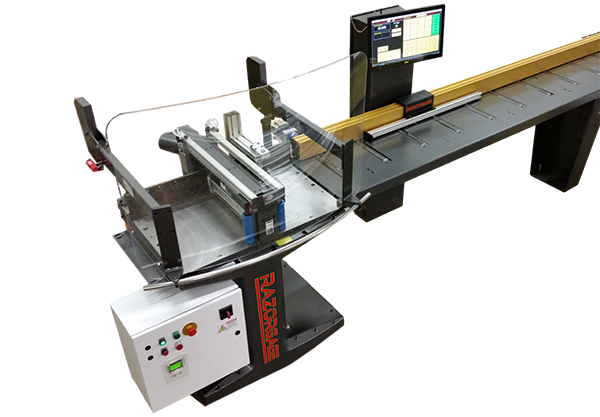
Pairing positioning systems with an automatic upcut saw creates a controlled, repeatable cutting environment. Material is positioned precisely, held securely with clamps, and cut with smooth, consistent motion.
It’s important to understand the distinction here.
Manual saws rely heavily on operator control.
Automated upcut saws improve consistency and reduce variability.
But when combined with positioning systems and software, you get an optimizing saw system. That’s where real efficiency happens.
For shops evaluating an upcut saw for sale, focusing only on the saw can be limiting. The real value comes from how well it integrates into a larger automated workflow.
The Role of Cyclone 600 Safety Features in Reducing Waste
Consistency isn’t just about measurement. It’s also about control during the cut.
The RazorGage Cyclone 600 is designed with that in mind. The industrial design incorporates a direct-drive motor that glides on machine tool-grade, recirculating ball linear bearings, providing ultimate durability. This reduces vibration compared to swing-arm systems, which tend to wear over time.
Less vibration means more stable cuts. More stable cuts mean fewer errors.
Material holding also plays a critical role. RazorGage saw systems use clamps, manual or automatic, to secure stock in place. The blade isn’t doing the holding. The clamps are there.
This ensures alignment stays consistent throughout the cut. That’s a big factor in reducing scrap.
On the safety side, features like 2-hand anti-tie-down buttons, electronic braking, and the ability to manually crowd the material to the fence help maintain control. Not just for safety but for precision too.
Productivity Gains That Indirectly Reduce Waste
Waste doesn’t always come from bad cuts. Sometimes it comes from rushed ones.
When setups take too long, operators hurry. Mistakes happen.
Automation reduces setup time. Cuts are programmed. Positioning is automatic. There’s less pressure to rush.
Operators shift from measuring and adjusting to monitoring and managing the process. That reduces fatigue. And fatigue is a major cause of errors in manual systems.
Over long shifts, that difference matters. A lot.
Stable workflows lead to predictable output. And predictable output leads to less waste.
Ideal Applications for Automated Cutting Systems
Automation isn’t just for large-scale factories. It fits a wide range of operations.
High-volume woodworking shops benefit from consistency and speed.
Cabinet manufacturers see improved fit and reduced rework.
Door and window production becomes more reliable with repeatable cuts.
Even aluminum and mixed-material environments gain better control over cutting processes.
Basically, any operation struggling with scrap, rework, or inconsistent output can benefit from automation.
Conclusion
Waste in cutting operations is rarely just a material problem. It’s a process problem.
Manual measuring, inconsistent positioning, and lack of optimization all contribute to it. Fixing those issues requires more than better operators. It requires better systems.
That’s where RazorGage stands out.
By combining automatic saw system technology, cutting list software, and advanced measuring systems, RazorGage creates workflows that reduce waste at the source. Not after the fact.
Shops don’t just cut faster. They cut with purpose. With consistency. With control.
And over time, that’s what makes the difference.
Looking to Improve Accuracy, Reduce Scrap, and Streamline Your Cutting Workflow?
Explore advanced solutions like upcut saw systems, automatic positioning, and integrated software at RazorGage.
FAQs
How Does Automation Reduce Material Waste in Cutting Operations?
Automation improves measurement accuracy and material positioning, reducing errors that lead to scrap. Systems like automatic pusher systems and cutting list software ensure consistent cuts and optimized material usage.
Is an Automatic Upcut Saw Enough to Reduce Waste?
Not entirely. While an automatic upcut saw improves cutting consistency, combining it with positioning systems and software creates a complete solution that addresses waste more effectively.
What Is the Benefit of Cutting List Software?
Cutting list software plans optimized cutting sequences, helping maximize material usage and reduce leftover scrap across production runs.
Do Automated Systems Replace Operators Completely?
No. Operators still play a key role in monitoring and managing workflows, but automation reduces manual measuring and repetitive tasks, lowering the risk of human error.