
How Automated Upcut Saw Systems Boost Precision and Profit in Cabinet Making
Ask any shop manager what kills profit margins on a busy afternoon, and they won’t point to raw material costs first. They’ll point to the scrap bin behind the cutoff saw. When face frame stiles come out a sixteenth off, or box components don’t square up at assembly, everything grinds to a sudden stop. Someone has to pause production, re-measure, and recut. Manual measuring on a standard cutoff setup introduces human error that adds up fast across an eight-hour shift.
That is where switching to automated cutting technology changes the game. By taking the tape measure out of the operator’s hands, you eliminate guessing games and lock in tight tolerances on every single run. This is what the RazorGage RG3 positioner can do for your operations.
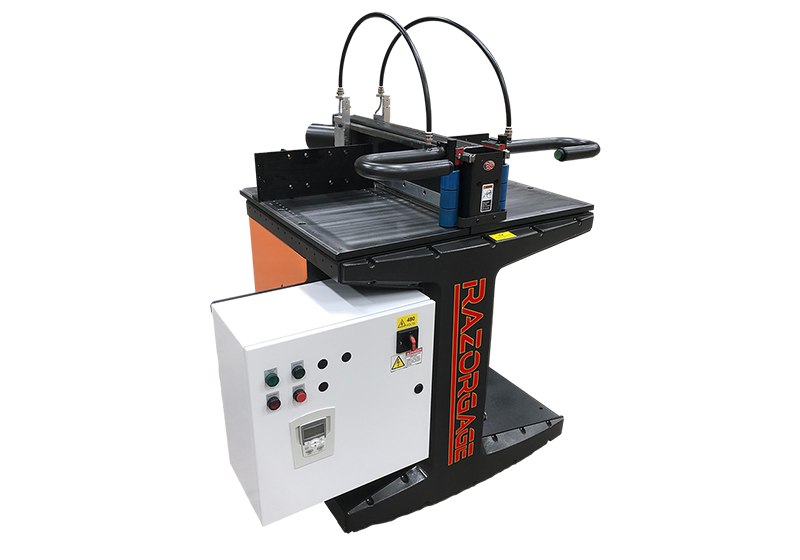
Further, when you integrate the RazorGage upcut saw into your cutting workflow, it gives you the structural rigidity, clamping power, and speed needed for demanding industrial woodworking. Whether you are building cabinets or manufacturing doors and windows, automated positioning and heavy-duty upcut machinery deliver the repeatability required to keep your assembly line humming without costly interruptions.
Why Accuracy Matters in Cabinet Manufacturing
In custom and commercial cabinet production, precision isn’t just about pride; it drives your daily bottom line. Small cutting errors create gaps, misalignment, and squareness issues that ripple straight down the line. A tiny discrepancy on face frame stiles or rails can stop drawer slides from tracking right or leave cabinet doors hanging crookedly.
When parts don’t meet print specs out of the saw, labor costs skyrocket. Craftsmen waste valuable shop hours sanding down long parts, trimming edges, or shimming frames on the bench. Instead of assembling boxes, your most skilled workers end up acting as fixers.
The financial loss doesn’t stop with extra labor. Tossed parts burn through inventory fast. Hardwood lumber and cabinet-grade sheet goods are far too expensive to end up as firewood. Consistently accurate cutting stops that bleed, keeps your rework low, and protects your profit margins on every job.
The Limitations of Manual Measuring and Cutting
Relying on manual measuring setups forces your shop to depend entirely on human consistency. Operators pull tape measures, mark pencil lines, and set flip stops hundreds of times a day. Even your best saw operator gets tired, deals with eye strain, or gets distracted. A thick pencil lead alone can introduce a 1/32-inch variance between parts.
Manual setups also chew up huge amounts of productive time. Reading cut lists, math calculations, and moving flip stops manually take up more time than the actual cutting stroke. That constant stopping and starting creates a massive bottleneck right at the primary processing station.
Worst of all, manual measuring lacks shift-to-shift consistency. Shift A might push stock tight against a stop, while Shift B pushes lightly or reads a ruler scale from a slightly different angle. That subtle variation makes part interchangeability a constant struggle across your workforce.
How RazorGage Automated Material Positioning Improves Accuracy
Automated length positioning removes operator guesswork from the measuring process entirely. Instead of moving manual flip stops or reading taped scales, RazorGage automated material positioning drives the stop automatically to the exact programmed dimension. The operator simply loads the stock, taps a button or selects a job, and lets the motor position the board.
Because the drive system operates digitally, length accuracy stays dead-on piece after piece. Whether you’re running ten face frame parts or two hundred shelf supports, part length never drifts. Utilizing RazorGage automated material positioning delivers repeatable, machine-tool-grade accuracy that manual setups simply cannot match.
That precision speeds up your entire cutting cell. Operators stop spending time double-checking tape measures or doing test cuts. By taking human measuring error out of the equation, your shop maintains strict quality standards regardless of who is running the machine that day.
The Role of Upcut Saws in Precision Cutting
While automated positioners manage part length, it’s the saw machine that really decides the end cut quality. The RazorGage upcut saw is made specifically for quick, exact cuts in wood, plastics, and other non-ferrous materials, so you get that consistent result. And unlike standard chop saws that pivot from above, these industrial upcut saw units keep the blade safely underneath the table, then during the cycle they send it upward through the workpiece, basically right where it needs to be.
Machine design dictates long-term durability and cut consistency. Many standard upcut saws use simple swing-arm pivot designs that develop play, vibration, and mechanical wear over time. Heavy-duty industrial equipment demands a higher standard. The Cyclone 600 features a direct drive motor that glides on machine tool-grade recirculating ball linear bearings, reducing vibration and increasing long-term durability. The industrial design incorporates a direct drive motor that glides on machine tool-grade recirculating ball linear bearings, providing ultimate durability.
Achieving clean, tearout-free cuts requires absolute material control during the blade stroke. To ensure clean cuts without splintering, RazorGage systems utilize clamps, manual or automatic, to hold material firmly in place. These pneumatic clamps secure the stock tight to both the table and fence before the blade touches wood. With a RazorGage upcut saw, secure clamping and rigid linear motion yield pristine, square cuts across your widest panel stock.
How a Programmable Saw Stop and Automatic Saw System Increase Efficiency
It helps to understand the difference between a standalone saw, an automated positioning stop, and a fully integrated system. Adding a programmable saw stop to your setup eliminates manual ruler positioning. Operators select cut files on an intuitive touchscreen, and the pusher moves to position instantly. When integrated into RazorGage’s optimizing saw systems, features like programmable saw stops, AutoList optimization software, and automated label printing turn a basic saw station into a high-speed production cell.
An automatic saw system takes batch cutting efficiency even higher. Once a cut list is loaded, the automated system advances stock, engages clamps, and cycles the saw automatically. Cycle times drop dramatically, throughput doubles, and operator fatigue vanishes.
Faster job setups mean less downtime when switching between face frame parts, drawer sides, and box components. You get seamless job transitions and predictable output every shift.
Safety Features Built for Production Operations
Industrial machinery must protect operators without slowing down shop productivity. RazorGage equips its cutting equipment with practical, modern safety engineering designed for fast-paced commercial shops.
Key safety features include 2-hand anti-tie-down buttons, electronic braking, and the ability to manually crowd the material to the fence. The two-handed control ensures operator hands stay completely clear of the cutting zone while the blade cycles. Electronic braking stops the blade quickly between cycles, while manual crowding allows operators to safely hold bowed lumber snug against the fence before clamping.
These safety mechanisms provide complete operator safety without sacrificing speed or usability on high-volume production floors.
Reducing Material Waste Through Automation
Cutting errors burn money fast. When an operator misreads a cut list and cuts a 12-foot board an inch short, that hardwood often ends up in the trash bin. Accurate positioning stops miscuts at the source, drastically reducing rejected parts and lowering your raw material bills.
Improving board yield directly protects your shop’s bottom line. When every board yields maximum usable parts, your lumber orders go further.
To stretch your lumber budget even more, RazorGage offers AutoList optimization software on its material positioners and optimizing saw systems. AutoList evaluates your entire cut list, scans board lengths, and calculates the most efficient cutting pattern in real time. It minimizes material waste and gives you maximum value from every board foot .
Integrating Automated Miter Saw Systems into Cabinet Production
Cabinet construction often involves angled components like crown molding, angled corner cabinets, face frame miters, and custom trim work. Automated miter saw systems bring digital accuracy to these tricky angle setups.
Manual miter setups require protractor gauges, test cuts, and fine-tuning that waste time and material. Automated miter systems adjust angles digitally, locking in exact degrees instantly without trial-and-error measuring.
Repeatable miter cuts ensure tight, gap-free joints on decorative moldings and face frames. That level of precision elevates your finished product quality while speeding up assembly times on custom cabinetry.
Ideal Applications for Automated Upcut Cutting Systems
Automated upcut cutting equipment delivers immediate upgrades across diverse woodworking environments:
- High-volume cabinet shops producing large runs of face frames, door components, and cabinet boxes.
- Custom cabinetry facilities needing rapid setup changes between short-batch jobs.
- Door and window manufacturers requiring tight tolerance processing on frame and sash components.
- Commercial millwork and furniture operations focused on maximum part throughput and clean cut quality.
- Woodworking facilities looking to eliminate scrap, lower labor fatigue, and scale shop floor output.
Conclusion
Precision cabinet making requires repeatable, dead-on cutting accuracy. Relying on manual tape measures and old pivot saws guarantees errors, material waste, and assembly bottlenecks. Upgrading your shop with automated material positioning, programmable measuring, and heavy-duty upcut machinery transforms your primary processing department into a reliable, efficient engine. RazorGage solutions empower your shop to cut faster, eliminate miscuts, and boost overall profitability.
FAQs
Why choose an automated upcut saw system over manual cutting?
Automated systems eliminate manual measuring errors, speed up setups, reduce waste, and deliver machine-tool-grade repeatability.
How do RazorGage systems ensure material stays secure during cutting?
RazorGage uses pneumatic clamps (manual or automatic) to hold stock firmly against the fence and table for clean cuts.
Can RazorGage systems help reduce lumber waste?
Yes. Accurate positioning eliminates miscuts, while optional AutoList optimization software maximizes board yield.
Are RazorGage saw systems suitable for custom cabinet shops?
Yes. Programmable saw stops allow fast setup changes, making them ideal for high-volume runs and custom batches.